

The Portrait of Teachers and Students
1, Brief Introduction
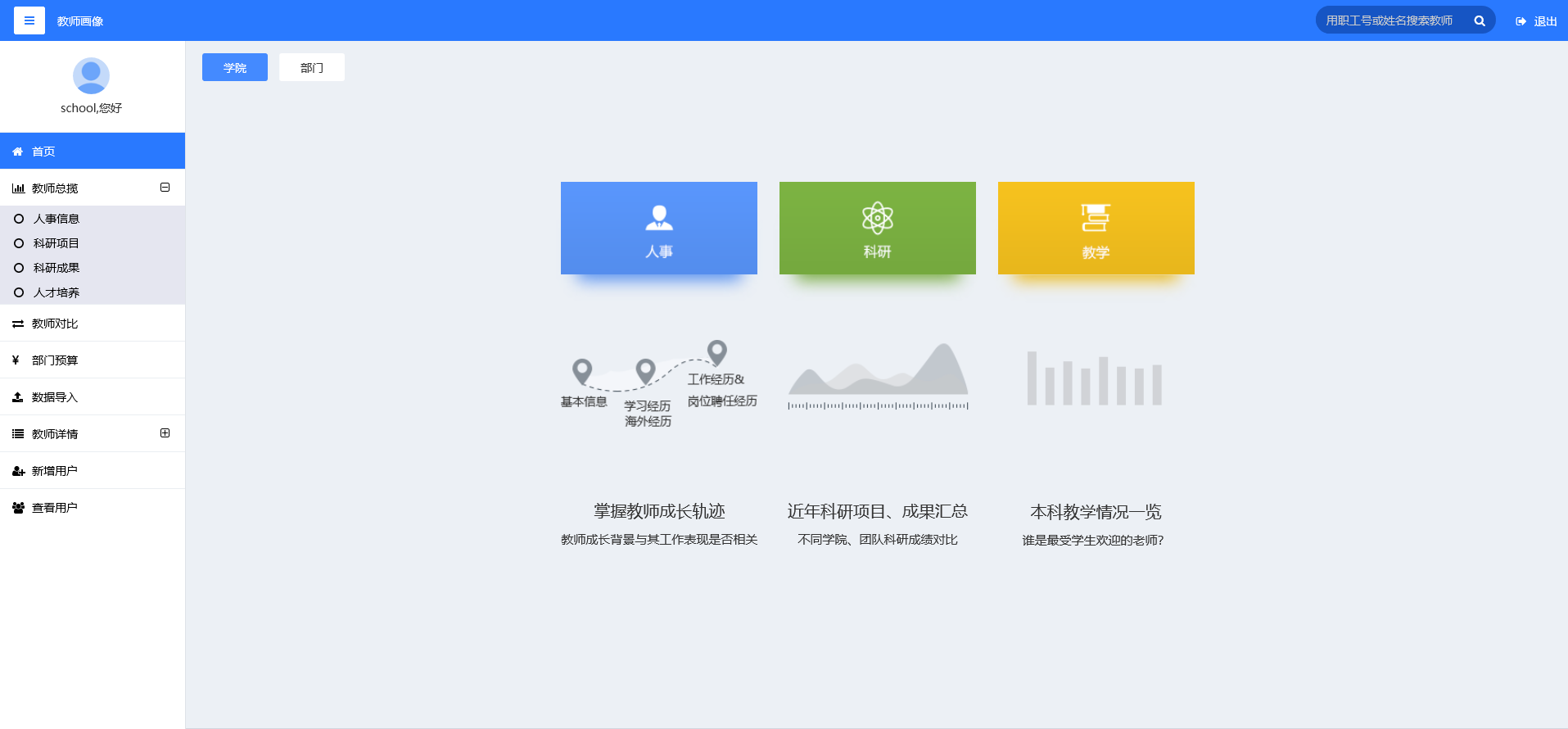
Home Page - The Portrait of Teacher
1.1 The Portrait of Teachers
The Portrait of Teachers provides insight through data mining by compiling data on teachers’ personnel, scientific research, finance, and educational affairs. The personnel information, scientific research results and teaching conditions of the individual teachers and groups are precisely and accurately described by the software. This will provide a quantitative basis for the teacher’s performance evaluation. Additionally, the information it provides helps analyze the influencing factors of a teacher’s development and guide the teachers’ individual development.
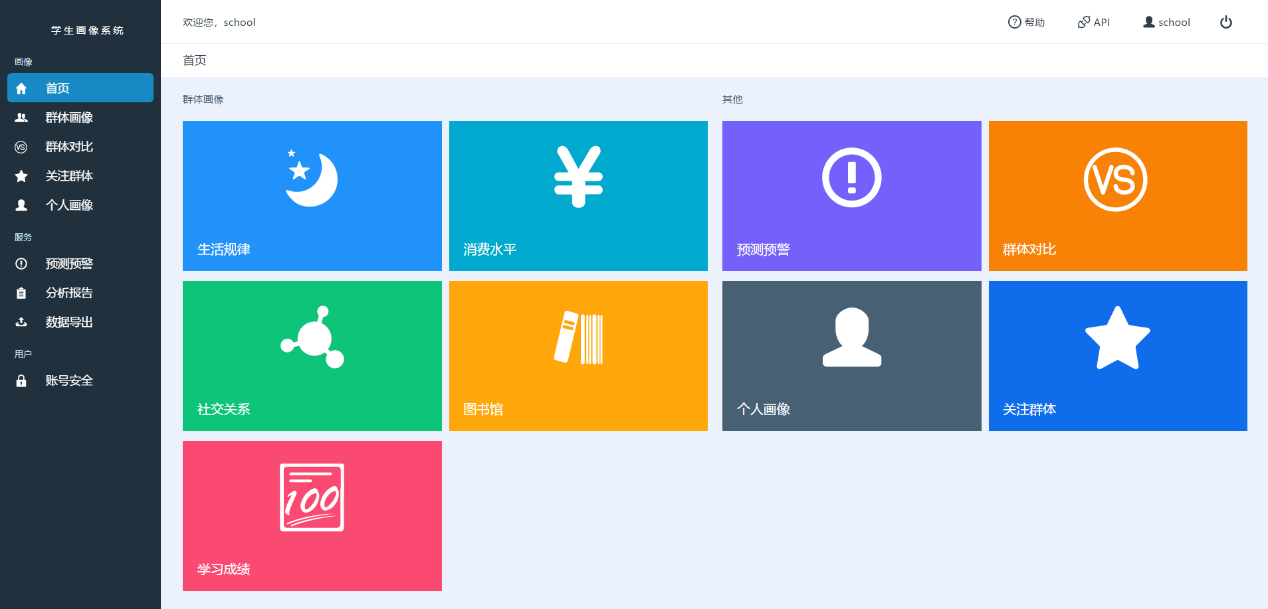
Home Page - The Portrait of Student
1.2 The Portrait of Students
The software portrays a complete student’s portrait that includes thorough data on safety, academic, life, employment and many other aspects. This helps any manager to fully acquaint with the student and achieve refined management. There are seven functions of the student portraits: comprehensive understanding of students, contact alert for missing students, grade prediction with a warning system, graduation result prediction and unemployment warnings, locating lonely students on campus, locating dormitory “over-homes” and accurately finding poor students through data mining.
2、Related Technologies
2.1 Data Collection
Data collection includes the collection of internal data and internet data
Various methods are used for the collection of the school data: database access, data open interface, and offline data import. The data sources can contain business system data and form data.
An Internet data design distributed crawler system based on Hadoop cloud framework, using MapReduce mechanism to achieve different website-information acquisition, is used. It also adopts a cloud storage framework to realize distributed storage of massive information and ensure data consistency. In order to avoid repeatedly crawling and storing data, and to save storage space, the Bloom filter algorithm is used to determine whether data exists and delete duplicate data. The content captured by the crawler is an HTML page or HTML fragment, which is parsed by regular matching and DOM parsing methods to extract the required data.
2.2 Data Govern
After obtaining the personnel, scientific research and teaching data of the school teachers, it will holistically combine the most important data sources, and establish data standards based on the Ministry of Education’s requirement and the actual situation of the universities themselves.
The main methods for quality testing of data sources based on the data standards are:
Missing rate detection of core fields;
Detection of repeated data;
Use the data standard to check the accuracy and coverage of the college's teacher data in every business system.
After the above three methods are analyzed, a data quality analysis report is outputted, and the outstanding data problem is recorded.
At the beginning of construction, each business system was not strictly restricting by rules, thus resulting in various data formats that couldn’t be recognized. As an example, the paper data in the scientific research system, which are named “paper publications”, can be filled freely. Due to this, the same publication has various expressions such as the English full name, English abbreviation, Chinese name, and etc. appearing simultaneously, while having other issues such as spelling mistakes, word abbreviations, and omission of words. In order to solve such problems, a text similarity judgment model is established, and a non-compliant name is mapped to a specification-compliant information in the form of manual review.
For exposed data problems, the program implementation and manual coordination are used to improve data quality and complete missing data. For example, if the employee number of the paper is missing from the scientific research system, the author's employee number is judged and completed by means of information association. Large amounts of redundant data scattered across different business systems are removed and the data is correlated from different business systems to integrate them into a unified database.
2.3 Data Storage
The bottom layer of the system is built with a distributed framework. The revision and secondary development are based on the open source distributed framework Hadoop. It mainly consists of two parts, namely distributed storage and distributed computing framework.
Distributed storage uses the HDFS distributed storage file system, which is reliable and suitable for deployment on inexpensive hardware. It adopts a triple redundant storage strategy for the data of the sub-center. Unstructured data is stored on HDFS and structured data is stored in HBase, which ensures data security.
The distributed computing framework adopts MapReduce computing framework, supports distributed algorithms, and performs distributed parallel computing on files on HDFS or HBase through Map mapping and Reduce protocol.
2.4 The Construction of Big data Analysis Model
Taking the portrait of student as an example, we collect the student’s consumption data, the library access control data, the dormitory access control data, and the imprint recorded from the students when they surf on the internet (student online records, web browsing history, etc.) in order to data log the student's life behavior at school and do further modeling based on the data.
2.4.1 Trajectory modeling
The first trajectory modeling method is time regularity modeling. The regularity of student life on campus is directly related to performance at school. Students with excellent grades have more regular lives, while on the contrary, students who fail on exams may not go to class often and tend not to self-study. These irregular students are more likely to sleep in a dormitory, read a novel or play a game. Therefore, the modeling of students' time rules is very important for mastering students' real-time dynamics, achieving timely monitoring and management of students.
The second trajectory modeling method is frequent sequential pattern mining. The regularity of time is only one aspect of the students' living habits. It doesn’t reflect on the order of location visits. For example, some students go to the cafeteria to have breakfast and then go to the teaching building. Other students may go to class to finish the first quarter first, and after class they go to the cafeteria to buy breakfast as their second task. Students with different frequent sequence patterns may have different academic performances. For example, the performance of a person who goes to the cafeteria for breakfast first may generally be better than ones that goes after class. This frequent sequence pattern is considered an important indicator of the regularity of life. Mining algorithms for frequent sequential patterns can be accomplished by using multiple algorithms, such as GSP algorithms based on search and pruning or HPY algorithms modeled in a probabilistic manner.
2.4.2 Network preference modeling
College students' thoughts and interests can be further reflected by their Internet activity. We collect online information about students through the network system (including when and what kind of websites the students click on and what information corresponds to different websites), and based on these data a three-dimensional tensor of user-time-URL can be constructed (tensor can be considered as an extension of the matrix, extending from two dimensions to n dimensions, n >= 3). Due to the large variety of URLs, each student visits a limited number of sites so there is a great similarity in Internet access between students. Therefore, this tensor can be reduced in dimension to explore the hobbies of students at different times. If some of these interests are found to affect his or her studies, managers can quickly supervise and educate the students about the issues that these interests pose.
3、Application
3.1 Teacher Portrait
3.1.1 Teacher Analysis
School leaders conducted teacher analysis based on this system. Using this system, problems related to topics such as the performance level of full-time teachers, the average age structure of full-time teachers, the pressure of associate professors, the correlation between teacher qualifications and teachers' work ability, the impact of overseas visits on teachers' publication of high-quality papers and other topics.
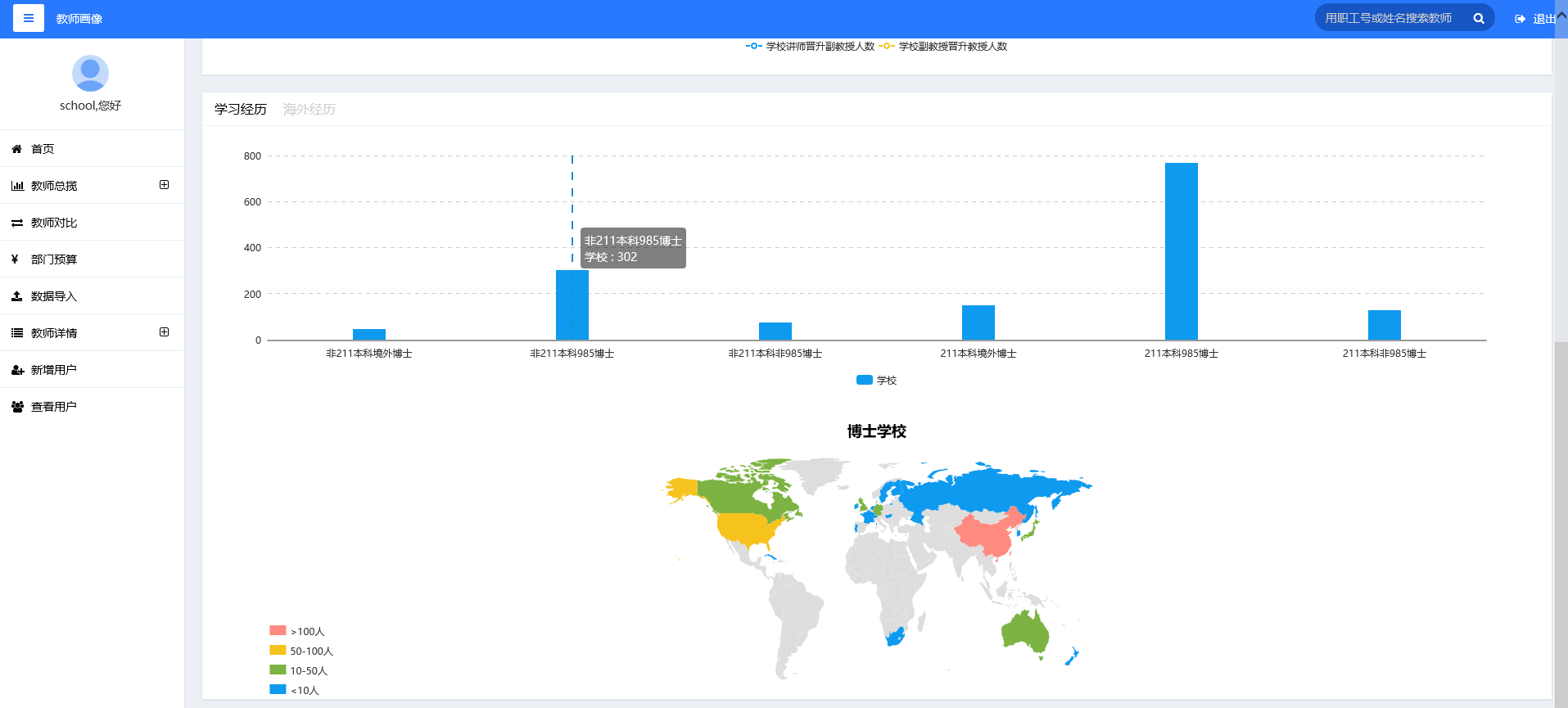
The Portrait of Teacher - Overview of teachers’ learning experience
3.1.2 Automatic evaluation of teacher job performance
The teacher's work performance automatic evaluation system integrates multiple types of data information such as personnel, scientific research, finance, and teaching. It adopts multi-dimensional evaluation factors such as teacher's financial efficiency, use of funds, influence of results, transformation of results, and peer opinions. It also supports different units for all evaluation types. The evaluation model is adjusted according to the actual situation of each unit, and the achievements of teachers in scientific research and teaching work are presented in all aspects. This results in a quantitative decision-making basis for teachers' entry, promotion, appointment, training and rewards and punishments. It avoids the influence of human factors on the traditional teacher performance evaluation, making the evaluation results more objective and accurate.
3.1.3 Work track assessment
“The Portrait of Teachers” analyzes the teacher’s development trajectory based on the teacher's basic information data (including learning experience, overseas experience, work experience, job hiring experience, research project, subject achievement, etc.), and focuses on teachers' professional quality, professional knowledge, professional ability, and job performance. We will build teachers' growth trajectories in many aspects, analyze the development factors that affect teachers, and develop individualized growth plans (such as predicting the number of published papers) to determine whether they can be selected for talent programs and find outstanding young teachers. At the same time, we want to develop a personalized development path suitable for teachers, guide teachers to sustainable development, and achieve a "win-win" for teachers and schools.
3.1.4 The Talent Circle
Building a talent network based on Internet data.
The School of Computing is the first to use this network to carry out talent introduction work.
3.2 The Portrait of Students
“The Portrait of Students System” is applicable to all kinds of colleges and universities across the country. It mines valuable data through the university student management database and builds an educational big data integration platform. Using the algorithm prediction and system modeling, it will find the various behaviors’ intrinsic connections to research and consider of the logical relationship behind them. This will ultimately achieve practical application results such as educational outcome prediction and abnormal behavior detection.
3.2.1 Graduation Prediction
It will clearly portray the relationship between graduation and the regular patterns of living habits and will compare the graduation destinations of previous graduates to predict the future graduation of current students.
3.2.2 Performance Prediction and Failure Warning
Based on the student's historical performance data and the school card behavior record, the students' performance ranking and the tendency of the exam failure will be predicted with early warnings given if required.
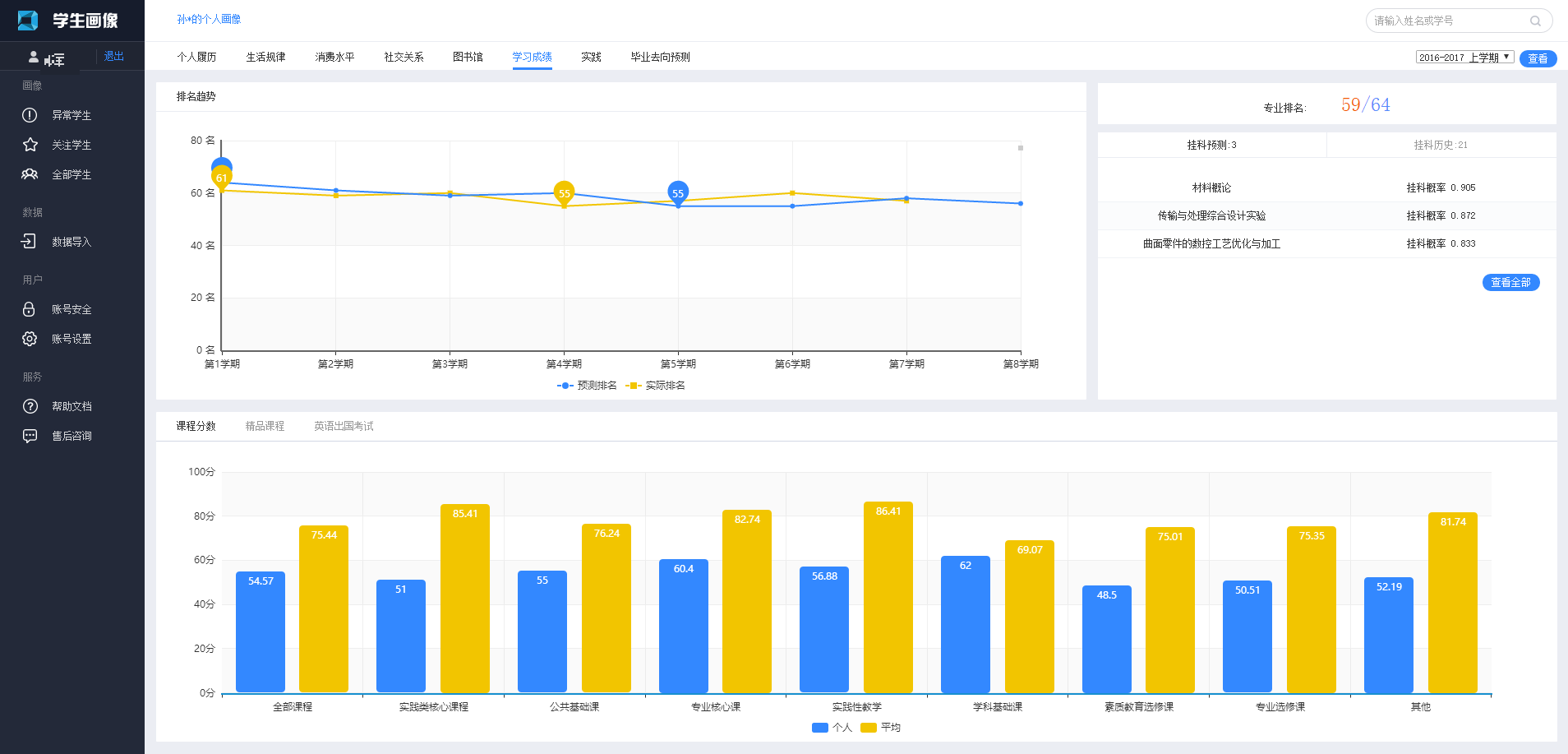
the Portrait of Student-Performance Prediction
3.2.3 Behavioral Abnormality Warning
Based on the data of Campus Smart Card, we can judge and warn of missing students so that the counselor can utilize the lost student joint warning function. When the student loses connection time for a duration that exceeds a certain threshold, the system will promptly push relevant warnings and information to the counselor.
3.2.4 Social Relationship Insights
Reveal the social relationships of the students in the campus, and use the student's professional, dormitory and other information to identify the student's social circle in the school.
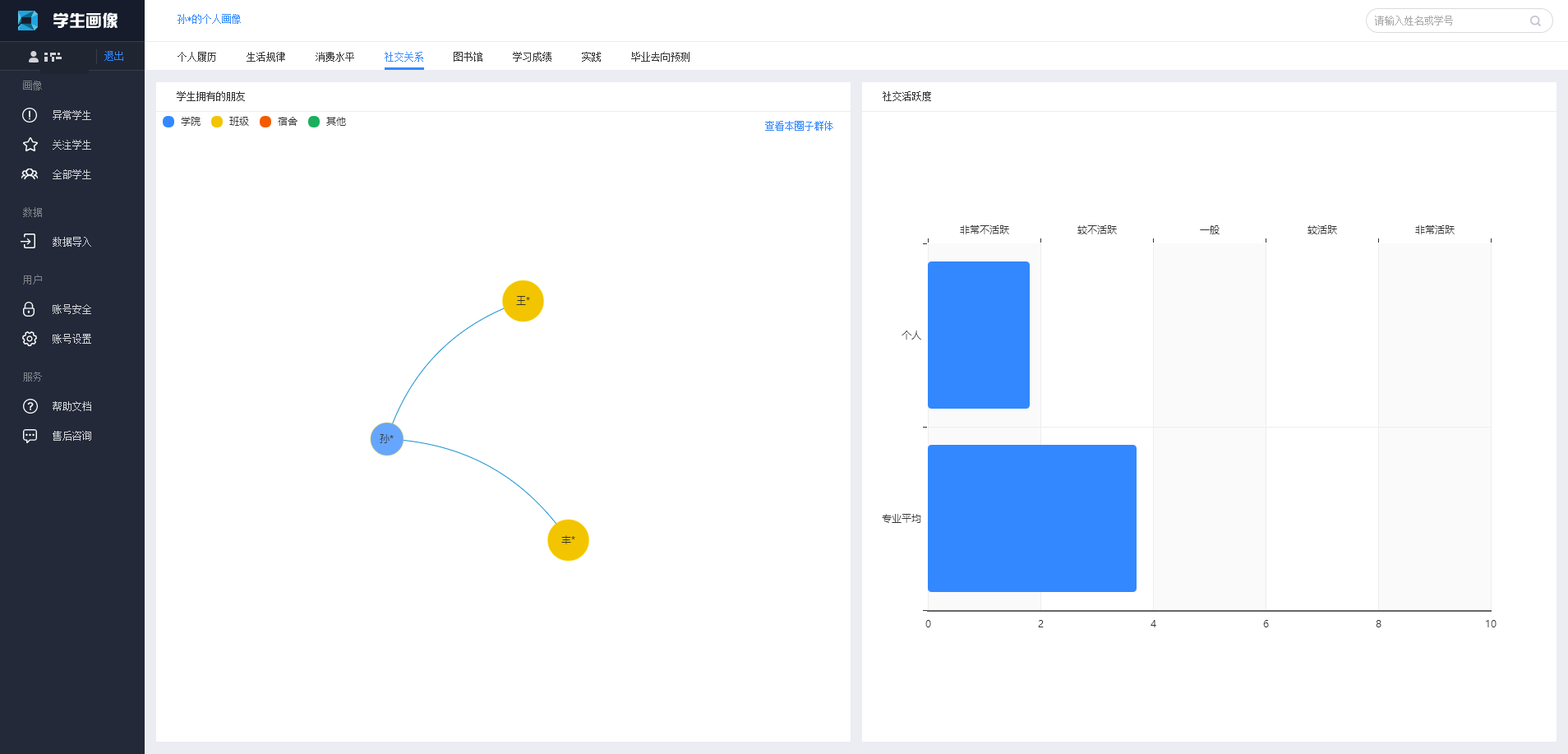
the Portrait of Student- Social Relationship Insights
3.2.5 The Awards and Student Loan Identify
The student’s consumption level is evaluated according to the data of the consumption behavior obtained from the smart card and based on this evaluation the student poverty index will be constructed to identify the student's awards, loans, and identification of “hidden subsidy”
(by Kai Yan, University of Science and Technology of China)
(release date:2018-12-07)
