

China CERNET Identity Federation
China CERNET Identity Federation
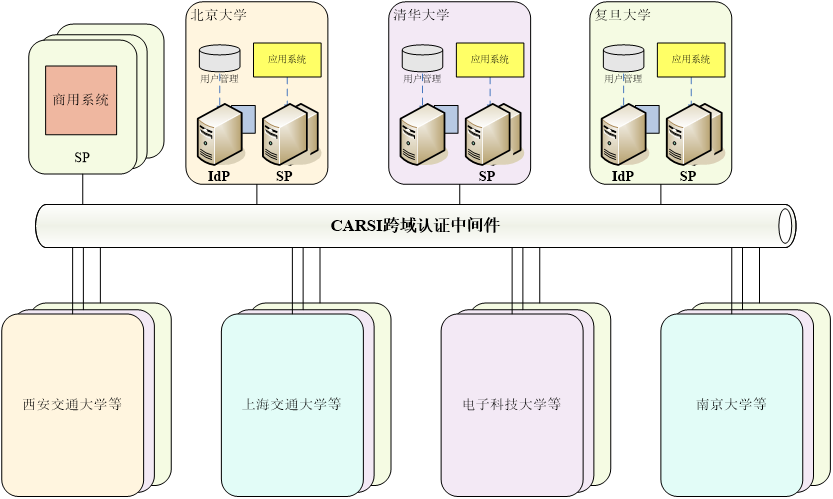
The CERNET (China Education and Research NETwork) Authentication and Resource Sharing Infrastructure (CARSI, https://www.carsi.edu.cn) was initiated by Peking University and developed for China CERNET identity federation. It provides cross-domain authentication and authorization services for universities and research institutes. Based on the campus-web identity management systems which have been widely established at most universities in China, CARSI aims at building an authentication and authorization infrastructure which enables the users of CERNET to access online resources shared by other national or international universities.
CARSI is based on US Internet2 Shibboleth. University campus-wide identity management systems which authenticate local user’s identity and release user’s attributes are connected as identity providers (IdPs). Applications which support visits from university users are connected as service providers (SPs) which control access by user type. Since Shibboleth is a de-facto international NREN standard, technically, resources in other NREN identity federations can be easily reused in CARSI. Currently, CARSI SPs are mainly library e-publishers, such as: Thompson Reuters, EBSCO, NATURE, RSC, Elsevier, iGroup/IEEE, Karger which cover more than 20 resources. Other services include MOOC platforms (for example Coursera), PKU-EU research projects, etc.
A list of CARSI IdP members can be found at http://ds.carsi.edu.cn.
In August 2017, CARSI submitted membership application to eduGAIN. The application has been in the process of evaluation for approval. After successful interconnection, the process to share online resources with federated international education and research networks would be significantly simplified.
Shibboleth/SAML
Shibboleth is among the world’s most widely deployed federated identity solutions, connecting users to applications both within and between organizations and is widely adopted by NRENs (National Research and Education Network). Currently it is supported by the majority of applications focusing on serving research and education. It facilitates the resource sharing among countries.
Shibboleth is an open-source project that allows sites to make informed authorization decisions for individual access of protected online resources in a privacy-preserving manner. The Shibboleth software is a web-based single sign-on system made up of three components: The Identity Provider (IdP) is responsible for user authentication and providing user information to the Service Provider (SP). It is located at the home organization, which is the organization which maintains the user's account. TheSP is responsible for protecting an online resource and consuming information theIdP. It is located at the resource organization. The Discovery Service (DS) helps the SP discover the user's IdP. It may be located anywhere on the web and is not required in all cases.
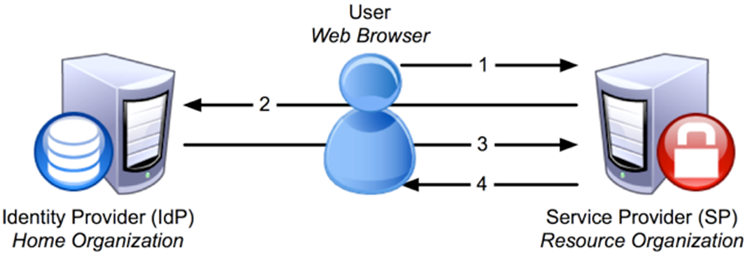
The following diagram shows the interaction between the user, located at their web browser, the IdP, located at the home organization, and the SP, located at the resource organization.
1. The SP detects the user attempting to access restricted content within the resource.
2. The SP generates an authentication request, then sends the request, and the user, to the user's IdP.
3. The IdP authenticates the user, then sends the authentication response, and the user, back to the SP.
4. The SP verifies the IdP's response and sends the request to the resource which returns the originally requested content.
International Identity Federation Development
There are currently 66 national identity federations all over the world, such as US InCommon, UK Federation, Australia AAF, Japanese GakuNin, Chinese CARSI, and so on. The Research and Education FEDerations group (REFEDS, http://www.refeds.org) provides a major channel of communication for national identity federations. Its mission is to voice the mutual needs of research and education identity federations worldwide. The group represents the requirements of research and education in the ever-growing space of access and identity management, working with and influencing the direction of other organizations on behalf of its participants.
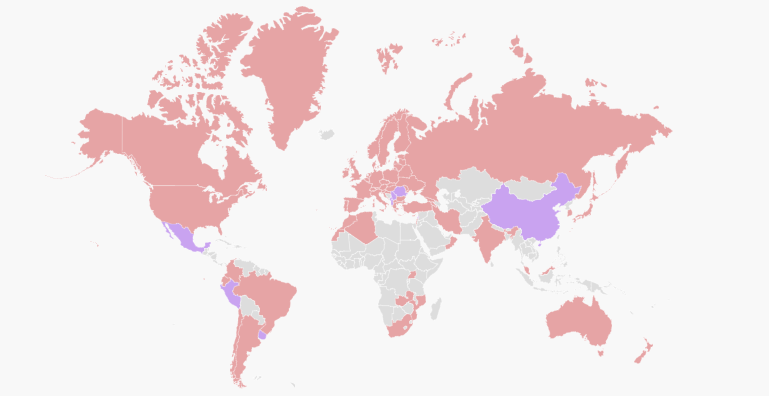
REFEDS currently has 52 full members, 14 associate members and 9 voting members. These members come from a wide range of backgrounds but share a common interest in developing access and identity management technologies, policies and processes. Some members represent national identity federations and some come from National Research and Education Networks (NREN).
REFEDS is managed by GÉANT in a way of providing secretariat support. REFEDS holds members meeting twice a year and carries out its work via the REFEDS wiki, the REFEDS mailing list and its working groups.
International Project – eduGAIN (https://edugain.org)
Unlike refeds, which focuses on identity management and identity federation technology development and deployment, eduGAIN provides an efficient and flexible way of inter-connecting participant identity federations, affiliated users and service providers. Currently, 55 identity federations around the world have either joined or in the process of joining eduGAIN, with more than 2,600 identity providers and 1,800 service providers.
Today, online services are crucial for research and education. Students, teachers, researchers and institution staff rely on them for collaboration through many web services. This can be for e-learning, teaching and conferencing, analyzing and sharing data, accessing journals and libraries, etc. With just one single trusted identity provided by user’s institution as part of an identity federation participating in eduGAIN, users can access services from other participating federations. Furthermore, it works with single sign-on (SSO), which means users need to log in only once during a browser session.
R&E identity federations are typically deployed on a national level and use different architectures, systems and policies. eduGAIN enables identity federations to interconnect. Users, services and organizations who need to easily and securely manage access to services benefit from eduGAIN because identity federations enable them to reuse their existing systems to operate across borders without having to make many individual agreements.
China’s Other Identity Federations
The mechanisms of Shibboleth have been adopted in a variety of applications in China. In addition to CARSI, other major identity federations include CSTCloud Federation, Shanghai EAC (Education Authentication Center) and CALIS (China Academic Library & Information System)
• China CSTCloud Federation
China CSTCloud Federation is a non-profit computer network managed by China Science & Technology Network and under the leadership of Chinese Academy of Science (CAS). CSTCloud uses a unified account system for users to access various research services, such as Research Online, Group Document Library, Conference Service Platform, Research Homepage, CAS email system, Information Aggregation Platform, and many more services to be available in the future.
• Shanghai EAC
Shanghai Education Authentication Center (EAC) is one of the three centers planned to be built as part of the project “One network, two platforms and three centers” to achieve informationization of education in Shanghai. The goal of EAC is to form a school federation that supports the agreements made by all participating schools and allow each school or even each grade across the entire Shanghai area to have their own identity management. It will enable single lifetime identity and monitoring students learning process so as to provide data base for individuals growth analysis. Also, it is designed to be compatible with international de facto standards and will become an important identity source to support applications within and outside educational institutions. Typical projections supported by EAC include Shanghai Education Wifi, Minor Courses offer among universities, “Huiyuan” (a platform for constructing and sharing high-quality education resources in Shanghai area), China Eastern Campus Incentives.
• CALIS Unified Identity Authentication
The China Academic Library & Information System (CALIS), one of the three Chinese Higher Education Public Services initiated during the early stage of CERNET construction, is a university library federation with its national center located at the library of Peking University. The goal of CALIS is to create an online digital library by using advanced identity management and access control technologies. This library aims at building a database from the vast amount of web information and services from various sources and make them easily accessible online, which will provide sustainable support for Chinese higher and public education and promote international academic exchanges.
The Unified Authentication Service (UAS) is one of the key services that CALIS provides. Running as a SAAS service, UAS provides identity management for university library users and public resources sharing for CALIS federation participants. More than 1300 higher education institutions are currently using UAS. Currently, CALIS users access shibboleth resources through CARSI due to some technical reasons.
(By: Ping Chen)
(release date:2018-12-05)
