
2020 (3rd) China IPv6 Development Forum Held in Beijing
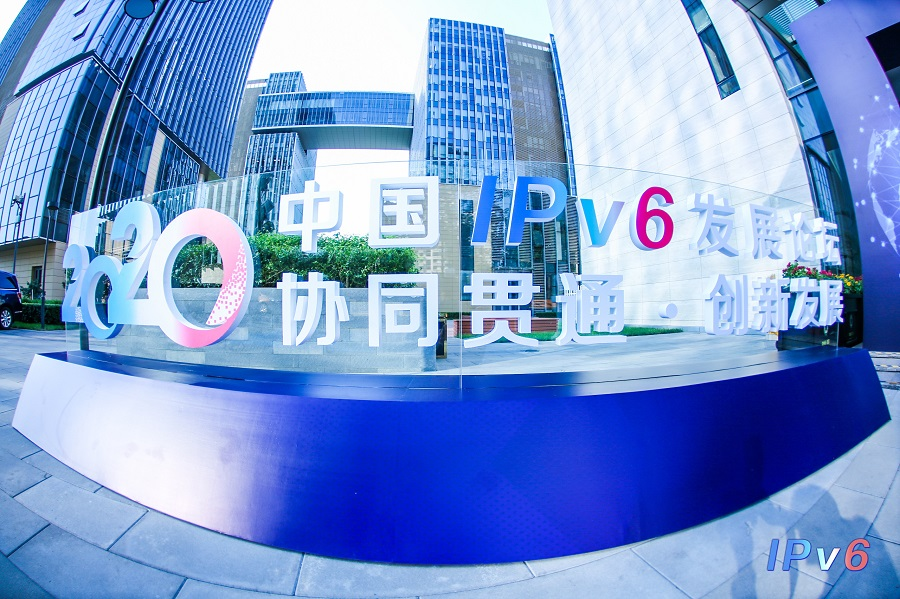
Deputy Director Yang Xiaowei stated that promoting the large-scale deployment of IPv6 is a major move in response to General Secretary Xi Jinping’s important thoughts on building China's strength in cyberspace. Since the Central Cyberspace Administration of China and the National Cyberspace Administration issued the Action Plan for Promoting Large-scale Deployment of Internet Protocol Version 6 (IPv6), the central and national governments has cooperated with each other in establishing a linkage mechanism and enhanced coordination to ensure progress are made and thereby promote the deployment of IPv6. Government departments at all levels have fulfilled their duties to play a leading role model. Baseline telecommunication operators have completed IPv6 upgrade for LTE network and fixed network, while websites and applications of established internet companies have been launched on a large scale.
While affirming the achievement, we should also reflect on our shortcomings to find existing gaps and make improvements. Besides consolidating current progress, we should establish a long-term mechanism for sustainable development to expand the width and depth of our work. Meanwhile, we should enrich IPv6 application resources, improve IPv6 service quality, actively build an industrial ecology that can better serve the development of IPv6, constantly improve the capability of ensuring cyber security of enterprises and establish an interconnected and highly effective coordination mechanism, so as to make concerted efforts to promote the large-scale deployment of IPv6.
He also pointed out that in future work, we should make overall plans to enhance coordination under the guidance of Xi Jinping Thought on Socialism with Chinese Characteristics for a New Era, strengthen efforts in responsibility fulfillment and thereby realize the targets and tasks set for the year of 2020. At the same time, we should focus more on the priorities by encouraging more internet applications to implement IPv6 upgrade, so as to improve the performance of IPv6 network service, offer support for users using IPv6, and thereby realize in-depth progress of various tasks. Besides, we should promote innovation in cutting-edge IPv6 technology, strengthen experimental verification and application demonstration of new IPv6 network technologies and applications, and thereby expand the application scope of IPv6.
According to Director Wen Ku, at present, network infrastructure has been fully upgraded to IPv6, with the network quality of IPv6 almost the same with that of IPv4. The IPv6 service capability of basic infrastructure like data center, content distribution network and cloud service platform has been constantly improved. Mainstream mobile terminals and smart family gateways device now all supports IPv6, and IPv6 upgrade has been completed for the web portals and self-operated APP of baseline telecommunication operators. In the next step, we should accelerate the large-scale deployment of IPv6 in an all round way concerning such four aspects as cloud, administration, terminals and users, and improve the quality and coverage of IPv6 network service. Besides, we need to enhance the ability to support IPv6 of fixed terminals to accelerate the IPv6 upgrade and replacement of existing smart family gateways, and encourage IPv6 upgrade of applications by promoting major application stores to investigate and identify the popularity of IPv6.
As stated by Vice President You Zheng, the global Internet is undergoing a critical period of transition from IPv4 to IPv6, also facing unprecedented opportunities of internet technology innovation. Under the support of relevant authorities in Haidian District, Beijing, Tsinghua University and CERNET has jointly constructed an innovation park for major application technologies and internet of the next generation, achieving a leapfrog development of the Internet industry and its application innovation and contributing to the development of the next generation Internet in China.
In his keynote speech, Academician Wu Hequan stated that as of July 2020, the proportion of LTE users that have been allocated with IPv6 addresses in China has exceeded 90%, with active IPv6 users reaching 362 million, accounting for about 40% of Chinese netizen. What's more, the total IPv6 traffic of the three major baseline telecommunication operators has reached 4372Gbps, with IPv6 traffic accounting for 10%. Given the fact that the top 100 commercial websites and applications in China have already supported IPv6 access, it can be concluded that significant achievements have been made in the large-scale deployment of IPv6.
At the forum, the committee of experts promoting IPv6 large-scale deployment released the White Paper on the Status Quo of China's IPv6 Development, held a result release ceremony and such sub-forums as "IPv6+ Industry Salon" and "IPv6 and New Development in Education and Scientific Research". Nearly 200 representatives from government departments, state-owned enterprises, basic telecommunications companies, Internet companies, scientific research institutes and financial institutions have attended the forum.
release time:2020-09-14
