
China’s Number of IPv6 Addresses Now Leads the World
In April 2021, the national major science and technology infrastructure project "Future Network Test Facility: FITI (Future Internet Technology Infrastructure)", co-built by 40 colleges and universities including Tsinghua University, obtained the /20 hyperscale IPv6 address block allocated by APNIC (equivalent to 4,096 /32 addresses). As a result, the number of IPv6 address blocks owned by China reached 59,038 /32, exceeding America’s 57,784 /32 address blocks and leading the world. (Note: one /32 address block contains 296 IPv6 addresses; one /20 address block contains 212 IPv6 addresses)
As reported, the "Future Internet Test Facility FITI" project co-built by 40 colleges and universities such as Tsinghua University is based on native IPv6 technology, aimed at providing an international leading open experimental environment for the research and design of future Internet architecture. This is also another major Internet experimental platform undertaken by China Education and Research Network (CERNET). FITI, based on a fiber optical communication network covering more than 30,000 km nationwide, has its backbone network core nodes distributed in more than 40 colleges and universities in 31 provinces, autonomous regions and municipalities, able to support 4,096 large-scale experimental networks simultaneously.
This acquisition of the /20 hyperscale IPv6 address block enables FITI to synchronously create 4,096 large-scale network test environments, connect with the global IPv6 Internet, and simulate the operation and application of hyperscale future Internet.
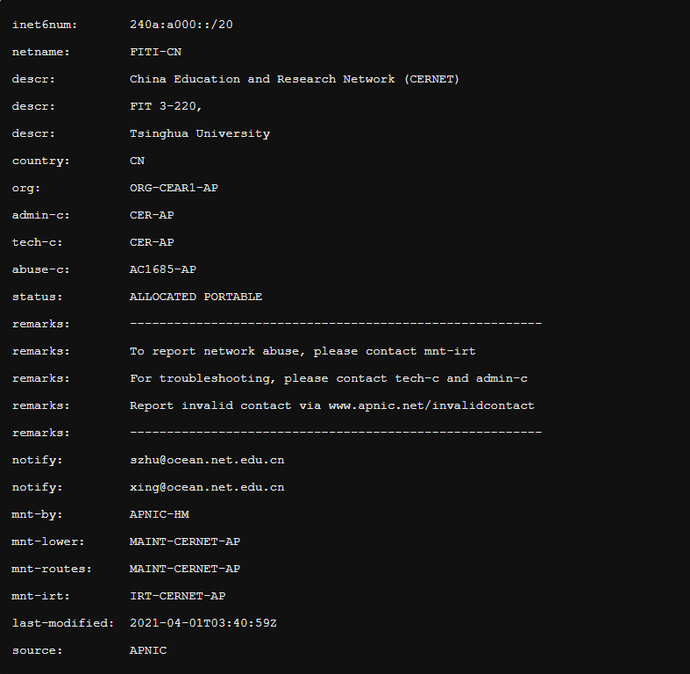
Information about the IPv6 address block obtained by FITI
Nowadays, with the running out of IPv4 addresses, a transition to IPv6 is an irresistible trend. The top leadership of IETF-- IAB issued an important statement on supporting IPv6 development in November 2016, noting that the future new protocols should all be optimized on an IPv6 basis. And this is a very important milestone in the development of the Internet, indicating that IPv6 has become an indisputable development trend and direction of Internet technology.
As early as 1998, CERNET got down to the research and application of next-generation Internet. And the world's largest native IPv6 Internet backbone CERNET2 was later launched in 2004. On that basis, CERNET actively participated in the formulation of international Internet standards, and formed several next-generation Internet standards (RFC), which has greatly promoted China’s research and industrial development on next-generation Internet.
In November 2017, the General Office of the CPC Central Committee and the General Office of the State Council issued the Action Plan for Promoting the Scale Deployment of IPv6, emphasizing seizing the historical opportunity of accelerated innovation and transformation of global network information technology and rapid evolution and upgrading of information infrastructure to strengthen overall planning and speed up the scale deployment of IPv6.
As China attaches great importance to the development of next-generation Internet IPv6, the number of IPv6 active users and traffic in China has increased rapidly in recent years, and great achievements have been achieved in the scale deployment of next-generation Internet. This is inseparable from the efforts of the three domestic communication operators and CERNET that has been committed to IPv6 research and practice. China’s number of IPv6 addresses now leads the world, which undoubtedly marks a milestone and a new starting point for the development of China's next-generation Internet.
(Source: www.edu.cn)
release time:2021-05-19
