
Shandong University: Analyzing the Remote Services for Digital Library Resources Based on Big Data
The university library offers a variety of remote digital resource services. This article introduces the development of the off-campus remote access system, CARSI, SSL VPN and WebVPN as well as conducts data mining. Through the results of data analysis, it reflects the effect and ability of the remote services for digital library resources, aiming to provide data support for the library to carry out in-depth personalized remote services for readers’ digital resources.
The Remote Digital Resource Services in the University Library
With the progress of society, we have seen flexible and diverse services provided by the university library. In terms of hardware, it improves library facilities and fosters a favorable reading atmosphere. In terms of software, the use of various application systems upgrades the all-around information technology ability of the library.
Besides, more and deeper services have come true through the Internet, such as online consulting services, remote digital resource services and mobile reading services, etc. The data analysis of the service effect provided by the Internet will elevate the service ability of the library.
According to the fact database system of university libraries by China’s Ministry of Education, in 2019, the total purchase cost of digital resources of 1151 university libraries was 3.721 billion yuan, accounting for 54.6% of the average purchase cost of literature resources. Since 2013, the input of digital literature resources has gradually exceeded that of paper-based literature resources [1].
The development of Internet information technology has expanded the types of digital resources, making them develop from simple digital journals in the early days to various digital resources at present. The number of digital resources is also on the rise.
Currently, it is the most basic literature guarantee for the comprehensive university library to have hundreds of Chinese and foreign digital resources. As digital resources develop, users need to access any digital library resources whenever and wherever possible through the convenient and speedy Internet to meet the needs of teaching and scientific research.
Driven by user service, the university library has changed from the single remote service mode in the past to seeking multiple remote services to solve the drawbacks of the former. At present, the mainstream remote service technologies include cross-domain technology, URL rewriting, VPN proxy service, reverse proxy service, Shibboleth authentication, and so on.
The provision of multiple remote services not only satisfies users' diverse access needs but also maximizes the benefits of digital resources on the premise of protecting the interests of database providers. After the university library provides a variety of remote services, we should consider the application effect and evaluation of each remote service mode.
This article conducts data analysis on the diversity of remote digital resource services at Shandong University Library. Through the combination of users’ access data and resource utilization data, it analyzes the effect of remote digital resource services on readers.
The Remote Service Based on the URL Rewriting Technology
The Off-campus Remote Access System
Developed and designed independently in 2003, the off-campus remote access system of Shandong University Library was open to teachers in 2004. It is one of the first-batch university libraries to use remote digital resource services in China.
In 2006, the system was first upgraded by cross-domain Cookie technology. In 2008, the school cooperated with enterprises to develop a unified authorized access system for university library resources by adopting URL rewriting technology.
In 2012, the system could be logged in successfully with two methods---unified campus-card identity authentication and account registration. Meanwhile, it increased multiple management functions [2]. In 2017, the system upgraded its security to get used to the school’s authentication mode. The CAS interface mode is adopted to realize the single-docking unified identity authentication system.
From 2004 to 2015, the off-campus remote access system was the only service mode of the school’s remote access to digital resources.
With the continuous development of computer technology, the system also keeps improving various performances to satisfy the growing needs of users: The improved stability has made it open to all school readers gradually, while it was available only to teachers in the early stage; the number of users has increased from dozens of early online users to 999 concurrent users; with the upgrading of functions, the configured digital resources have developed from more than 20 databases early to more than 130 databases.
Based on the continuous improvement and perfection of the above functions, the collection and analysis functions of resource statistics and readers’ behavior data are gradually added to the system as well. This will provide data support for analyzing the remote digital resource service ability of the university library.
Data Analysis
To analyze the big data, this article selects the statistical data of the system from 2016 to 2020 as its research object. As shown in Figure 1, the number of clicks will be analyzed first.
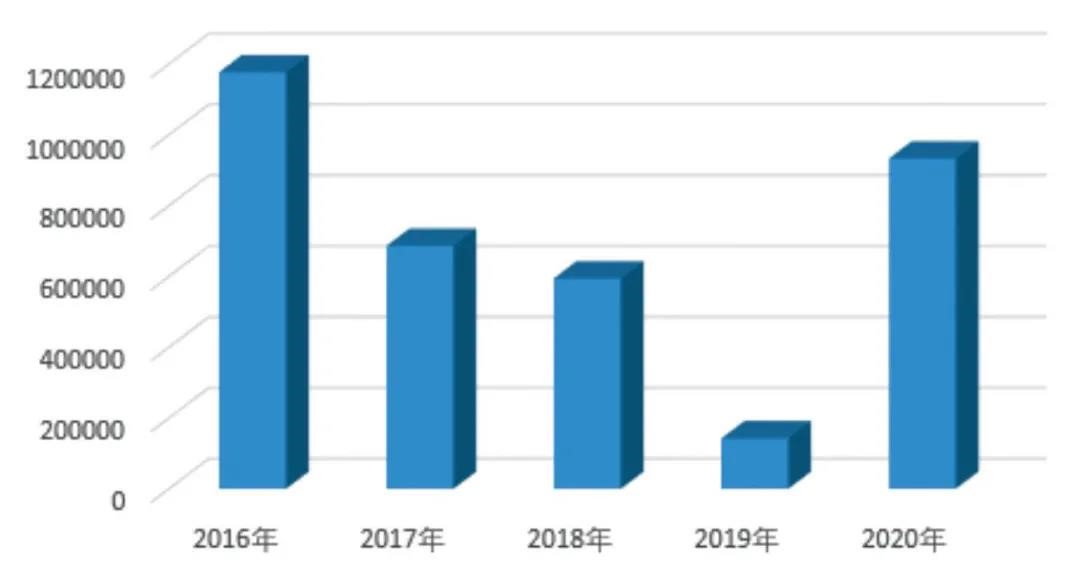
Figure 1 Access Amount of the Off-campus Remote Access System
from 2016 to 2020
It can be seen from the access amount in the five years that the number of visits in 2016 was the highest, with a total of 1.17 million, and then it showed a downward trend year by year. The reason for the decline was not that readers' access demand declined but that the school began to provide the VPN service to access off-campus digital resources in the same period. The combination of the two kinds of remote digital resource services not only facilitates readers but also reduces the load pressure of a single remote digital resource service.
The number of visits dropped sharply in 2019. Combined with the status quo and the specific data analysis, it should be ascribed to the following three reasons:
One is the change of users' access habits. Through the adaptation from 2017 to 2018, some users would inevitably transfer to VPN; the second is the access of a new remote service. In 2019, the school launched the WebVPN remote service, covering all the remote digital resource services of the library and solving the pain point that some databases failed to be accessed through the off-campus remote access system and VPN; third, the off-campus remote access system had been interrupted for a while due to server and data migration.
In 2020, the number of visits to the system rebounded to 930,000 rapidly, and the maximum daily visiting number reached 672. The system was under tremendous access pressure, meaning that during the COVID-19 pandemic readers' demand for off-campus remote access to digital resources increased, so they had to seek various ways to use the digital resources of the library.
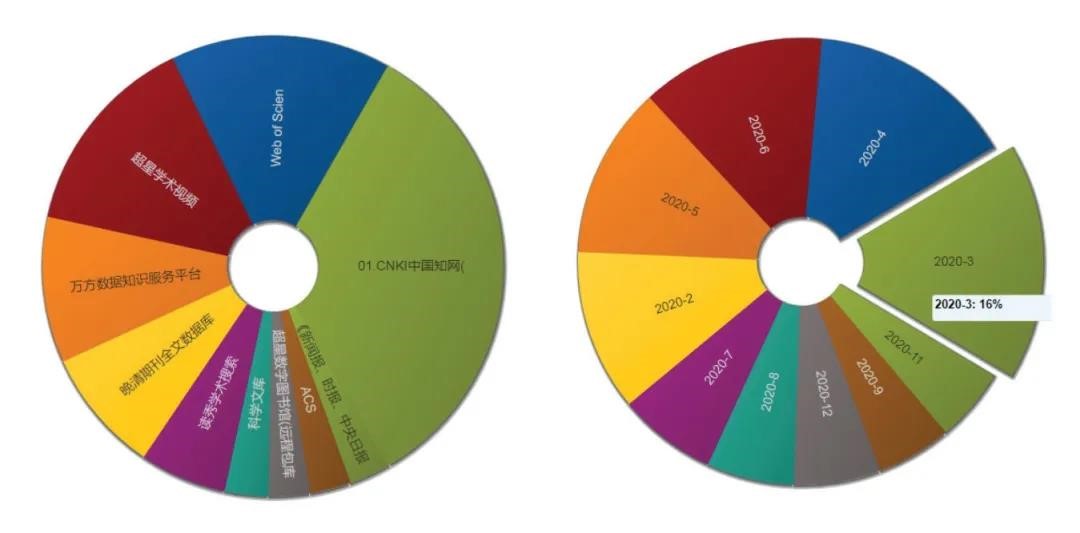
Figure 2 Resource Statistics and Monthly Utilization Statistics in 2020
Figure 2 analyzes the statistics of digital resource utilization and monthly utilization statistics in 2020. It can be seen that periodicals, videos, newspapers and search engines were all popular digital resources used by readers. It reflects that readers only used electronic journals to consult literature in the past but now they use a variety of digital resource services such as newspapers and videos.
During the online teaching period in spring 2020, the utilization rate of the system from February to June accounted for more than 50% of the annual visits. The number of visits in March reached 154,000, with an average of 5100 clicks per day.
By analyzing the access data in the five years and the detailed usage data in 2020, the use of the off-campus remote access system has achieved the expected effect. Users do not enter the physical library, but they are intimately around the services provided by the library. The remote digital resource service of the library has become an indispensable tool for the use of digital resources.
Going forward, the continuous improvement of library service ability should be reflected as follows: continuing to ensure the steady operation of the off-campus access system and providing 7x24 hours of remote service for readers; continuing to configure the newly added database; monitoring accounts with malicious downloads; the banning of accounts.
The Remote Service of ShibbolethCARSI
Shibboleth is an open source project for SSO (Single Sign On) in Intenet2 / MACE. It is mainly applied to the sharing of in-campus Web resources and the joint authentication of user identity for in-campus application systems. Overseas electronic resources generally support the authentication service of Shibboleth, which facilitates university users to directly log in and access these resources outside the campus in the real-name mode [3].
In 2013, the CALIS Management Center and the CARSI project team of Peking University jointly set up the CALISCARSI integrated service system for cross-domain authentication [4], allowing the remote service based on Shibboleth CARSI to be used in Chinese university libraries for the first time.
As the center of CALIS in Shandong Province, Shandong University Library was the first to join the service system. In the early stage, it opened seven foreign databases such as RSC and WOS through the campus card account.
At that time, the domestic database failed to support it technically. Coupled with the slow increase of accessible foreign databases, Shibboleth once fell into a bottleneck period in the application of Chinese university libraries.
On May 24, 2019, the identity authentication and resource sharing service of CARSI officially become the full-qualification member of eduGAIN, meaning that Chinese universities will be able to share the educational and scientific research resources of other countries more accessibly in the future.
During the COVID-19 pandemic in 2020, domestic databases such as CNKI, Wanfang and VIP had been added to academic resources successively. CARSI set off a climax in Chinese universities, and the external environment boosted the rapid development of CARSI in China.
In September 2019, Shandong University Library and the Informatization Office of Shandong University jointly submitted an application to the CARSI project team. The informatization office was responsible for the deployment of the IdP identity authentication system, and the library was responsible for the agreement opening and testing of academic resources. Shandong University is the sixth Chinese university to apply for accessing this service.
Data Analysis
As a remote service of identity authentication, CARSI has undergone nearly ten years of development in China. It breaks through the technical bottleneck and presents us with a convenient and speedy remote service.
2020 was a special year. Academic work and scientific research in universities posed an unprecedented challenge to the remote service of digital resources. The usage data of the CARSI remote service in 2020 will be analyzed below.
In 2020, Shandong University had a total of 907,000 authenticated visits through CARSIIdP. Statistics by resources are shown in Figure 3; Statistics by users are shown in Figure 4.
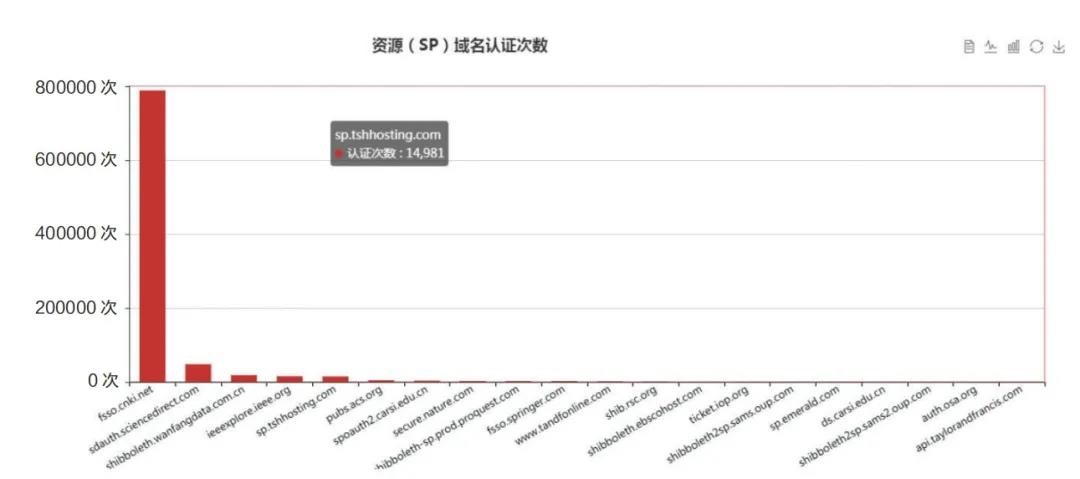
Figure 3 Statistics of Shibboleth CARSI Authenticated Resources in 2020

Figure 4 Statistics of Shibboleth CARSI Authenticated Users in 2020
According to the access amount, the top five digital resources were CNKI, Elsevier, Wanfang, IEEE and ACS. It can be seen that CNKI had much higher access than other databases. The number of user authentication in the top five was 7677, 4244, 4183, 1221 and 1080 in order.
By analyzing the data and combined with the specific practice, we can draw the following conclusions:
First, CNKI is the most widely used Chinese database.
Second, due to the frequent micro-adjustment of the CNKI application system, the configuration of the off-campus remote access system and VPN access needs to be modified at any time. However, the entry of CARSI identity authentication avoids the restriction of the third-party application system and realizes the direct authentication with the database, thus improving both the access speed and stability. When readers try to use it, they will change their old visiting habits and adapt to the new CARSI service.
Third, it is inseparable from the publicity and guidance of the library if a new service mode wants to be embraced and used by readers. The library specially customized the web page of accessing the CARSI service, with detailed operating instructions. As shown in Figure 5, readers can learn to use it by themselves.
Fourth, the highest number of single-user authentication was 7677, with an average of 21 per day, suggesting that users were gradually accepting the new remote service and transferring their access habits to the new remote service.
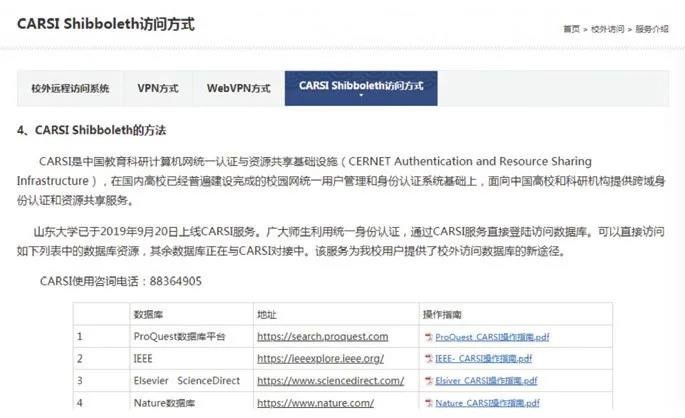
Figure 5 The CARSI Service Interface of Shandong University Library
There were also many difficulties in the process of using CARSI authentication. For instance, some readers' unified identity accounts were stolen, resulting in thousands of times of logging in an account in a day; Some accounts used the server script to download the full text of the database automatically, leading to the banning of the institutional account of the database by database providers.
All the abnormal situations require the library and the informatization office to cooperate closely and handle them from the background by technology and the non-perception method of users, such as banning accounts, releasing the ePPN attribute of the CARSI authentication terminal, and the real-time SP monitoring of the CARSI system.
The popularity of the CARSI remote service should be attributed to many factors. In 2020, the special external environment accelerated the promotion and use of the CARSI remote service. Academic resource providers also responded to the needs of users one after another in this particular time. The continuous participation of academic resource providers at home and abroad boosted the development of CARSI. When it comes to technical means, CARSI was constantly improving as well.
In November 2020, the "CARSI Resource Sharing Portal" supporting the mobile 1.0 version was launched, which integrated all accessible databases by CARSI; In December, the portal continued to upgrade its functions and realized the customized selection of subscribing resources for the school.
Following the progress of the CARSI project closely, Shandong University added the "CARSI Resource Sharing Portal" service module to the school's WeChat Work account in November. When the school found that there was no function of resource customization, it added the precautions for use. After CARSI launched the resource customization function in December, the library began to customize and check 145 resources in the background. After the completion of resource customization, the mobile terminal could access all the digital resources purchased by the library through one-time identity authentication.
Other Remote Services
The SSL VPN Remote Service
SSL VPN is a remote service mode provided by the Informatization Office of Shandong University for teachers, students and staff in remote teaching, scientific research and office work.
The SSL VPN system adopts VPN technology, which establishes a private network on the public network. It is composed of a secure communication tunnel established by two mutually authorized communication parties on the public network. The communication data conduct encrypted transmission in the secure tunnel, and the access is authorized in the network transmission layer [5].
At the initial stage, the school used VPN for remote office work rather than access to the digital resources of the library.
But in the process of usage, it was found that most VPN users used it to access the library's digital resources. Therefore, many problems arose when using VPN to access digital resources.
Due to a large number of digital resources, the routing table address of VPN overflowed frequently, leading to the irregularly inaccessible visits of the database. After the library confirmed that the VPN access was available through the daily traversal check, some users still had feedback about database failures, resulting in the situation that users cannot use them smoothly and library services were passively contained. The design architecture of VPN made the accessed digital resources through VPN fail to conduct data statistics and data analysis.
The WebAPN Remote Service
SSL VPN needs to install and download the client side when it is used. In view of the operational difficulties of some users, the school launched the WebVPN remote service in September 2019.
WebVPN is based on reverse proxy technology, which is different from the traditional VPN technology. WebVPN does not need to install the client side software and browser plug-ins. Users only need to enter the WebVPN page, input the unified identity authentication account, and log in to access the intranet resources through identity authentication. It is indeed efficient.
Compared with the complicated configuration process of the traditional VPN, WebVPN realizes zero configuration of the VPN system, thus reducing the threshold of usage and upgrading user experience [6].
In 2019, WebVPN was tested in the university. Shandong University Library cooperated with the informatization office to test multiple special types of digital resources. Despite a slow access speed sometimes, the management was convenient. It did not need to configure the front page, the secondary page, the retrieval page and the download page one by one like the off-campus remote access system and SSL VPN. Thus, the application effect was good.
Figure 6 shows the statistics of daily access, weekly access, monthly access and annual access of WebVPN in 2020. We can see from the data that five of the top ten websites visited in different time periods were related to the library, including CNKI, Han Tang Modern Newspaper Database, People's Daily, SCI and library websites.
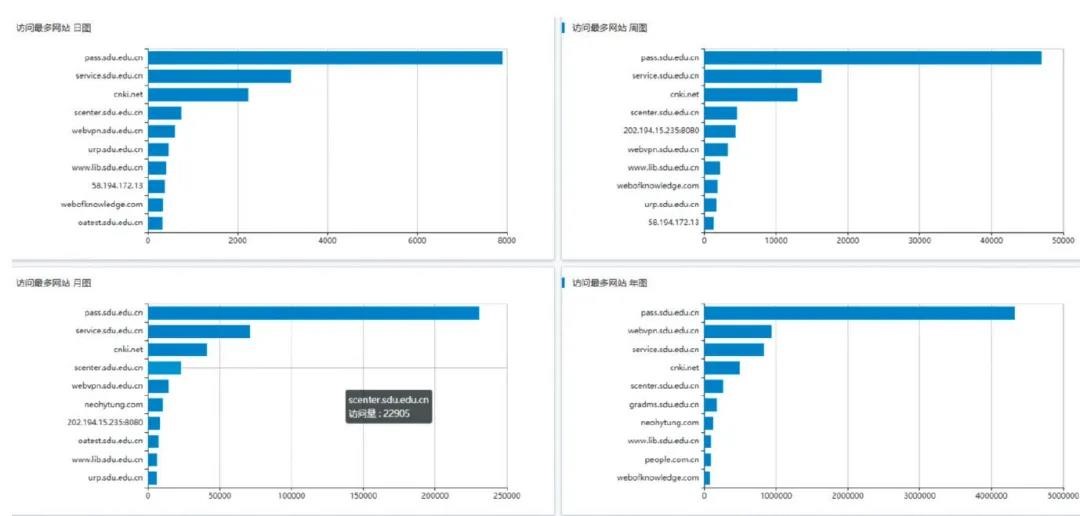
Figure 6 WebVPN Data Statistics in 2020
Through the data statistics, the access service for the WebVPN digital resources has achieved the expected effect. Liberal arts users tend to use WebVPN to access digital resources.
The MYLOFT Remote Service
In addition to the SSL VPN and WebVPN remote services, during the COVID-19 pandemic in 2020, the library tried to use the MYLOFT remote service.
As a new remote access tool for electronic library resources, MYLOFT supports users to remotely access the ordered electronic resources on the computer and the mobile terminal at the same time. It helps users manage and visit various digital resources through one window.
After the browser plug-in or the mobile app of MYLOFT is installed, users can keep the login authentication status when logging in for the first time and access the ordered digital resources whenever and wherever possible.
From March 18 to May 8, 2020, Shandong University Library's MYLOFT platform realized the access management of 16 databases in one window, with 67 access times. Despite a limited number of visitors, some readers had started to try.
During the test at Shandong University Library, the author paid attention to the test of MYLOFT at Tsinghua University Library. Tsinghua University Library configured 35 databases in the test phase, and all its primary databases were configured.
In September 2020, Tsinghua University Library officially purchased the MYLOFT remote service and configured 94 databases on this platform [7].
As per the comparative analysis of the data, the two university libraries attempt the same new remote service almost at the same time. In addition to the basic guarantee by the cooperative enterprises in technical means, the allocation number of digital resources, as well as the promotion, publicity and use guidance of new services, are all crucial aspects of the library's in-depth work.
The university library is a considerable institution to guarantee academic literature resources. On the basis of ensuring the type and amount of literature resources, how to raise the facilitation of using digital resources and provide ubiquitous services for users are the goal of library practice.
A variety of remote digital resource services can meet the access needs and expectations of different types of users, allowing them to get access to academic resources of the library anywhere and anytime with any device.
The effect and level of multiple remote digital resource services need the support of big data. Analyzing the meaning behind the data enables us to provide more targeted services for the library.
(Source: China Education Network)
release time:2021-06-29
