The year 2020 is a critical year for the implementation of the Action Plan to Advance the Scaled-up Deployment of the Sixth Version of the Internet Protocol (IPv6). According to the requirements of the Ministry of Education's "JJT[2018] No.3 Document", "By the end of 2019, the portal websites of colleges and universities should have completed IPv6 transformation." However, seen from the current monitored situation, there is still a considerable gap.
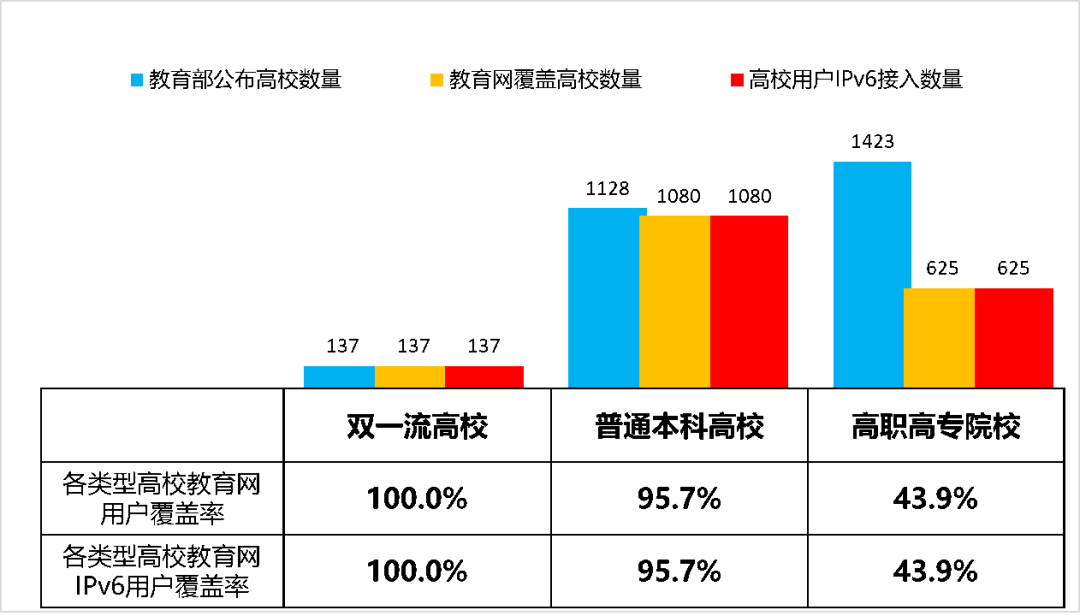
Figure 1. The IPv6 access situation of the members of CERNET (as of April 2020)
According to the monitoring data about the IPv6 WEB development condition of colleges and universities throughout the country released on http://ipv6c.cngi.edu.cn, as of June 10, 2020, the portals of 558 colleges could support IPv6 resolution, accounting for 18.9%; the portals of 428 colleges could support IPv6 access, accounting for 14.5%.
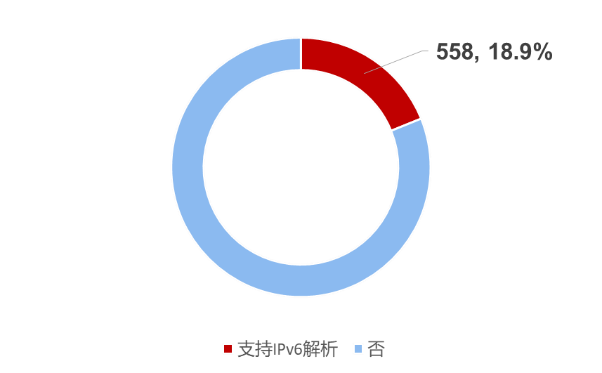
Figure 2 The proportion of college portals that support IPv6 resolution
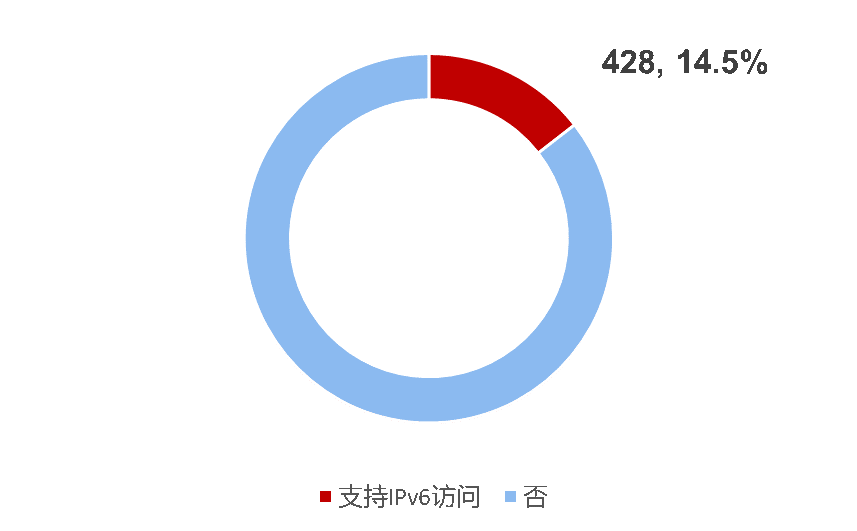
Figure 3 The proportion of college portals that support IPv6 access
As a matter of fact, most colleges and universities, especially those above the undergraduate level, now have access to IPv6 network. Taking CERNET as an example, there are 1,877 colleges and universities with access to CERNET2, reaching a coverage of 68.5%. To be specific, the CERNET2 access rate of colleges and universities of the double first-class construction program (first-class universities and first-class disciplines of the world) reaches 100.0%; it is 95.7% for ordinary undergraduate colleges and universities. And CERNET2 IPv6 service has been opened to all the users of CERNET.
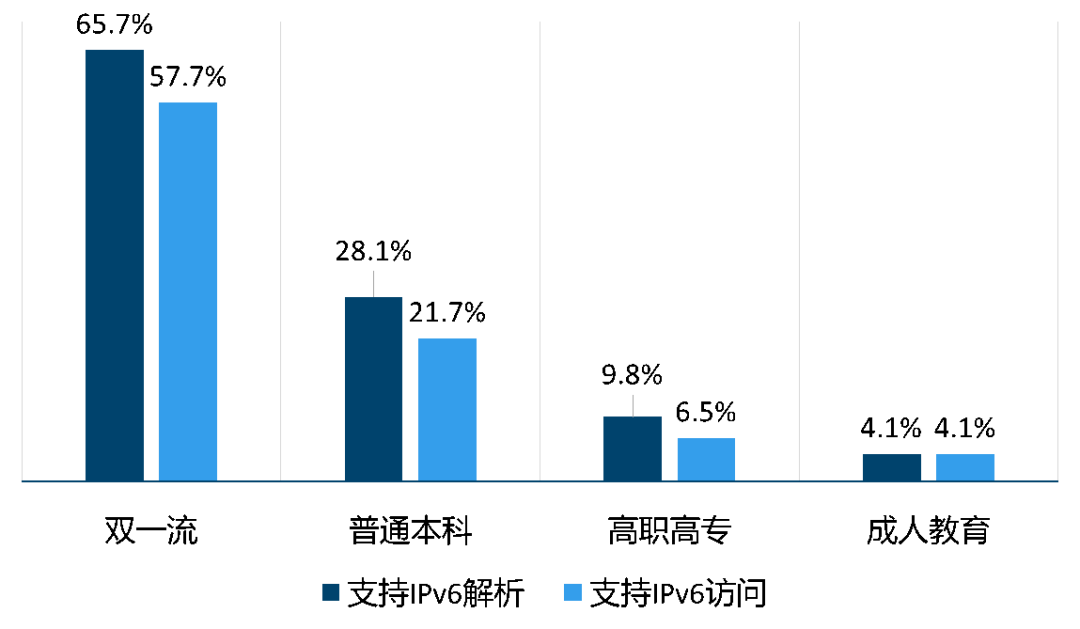
Figure 4 IPv6 support conditions of the portals of different kinds of colleges
According to the practical application of IPv6 network, the IPv6 traffic of CERNET2 nationwide is mainly distributed in Tsinghua University node, Peking University node and Beijing University of Post & Telecommunication node in Beijing as well as Tianjin, Shenyang and Xi'an nodes.
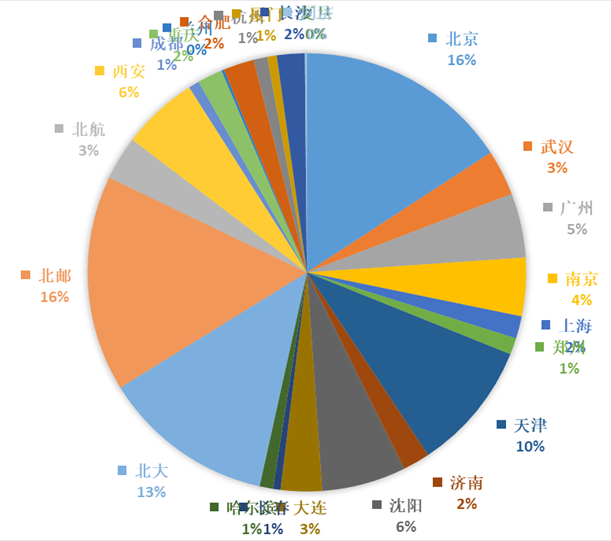
Figure 5 Nationwide CERNET2 Traffic Distribution
According to Zhang Chuang, Director of BUPT Information Technology Center, BUPT’s export of IPv6 traffic mainly benefits from the support of BUPT IPv6 network for large-capacity video applications.
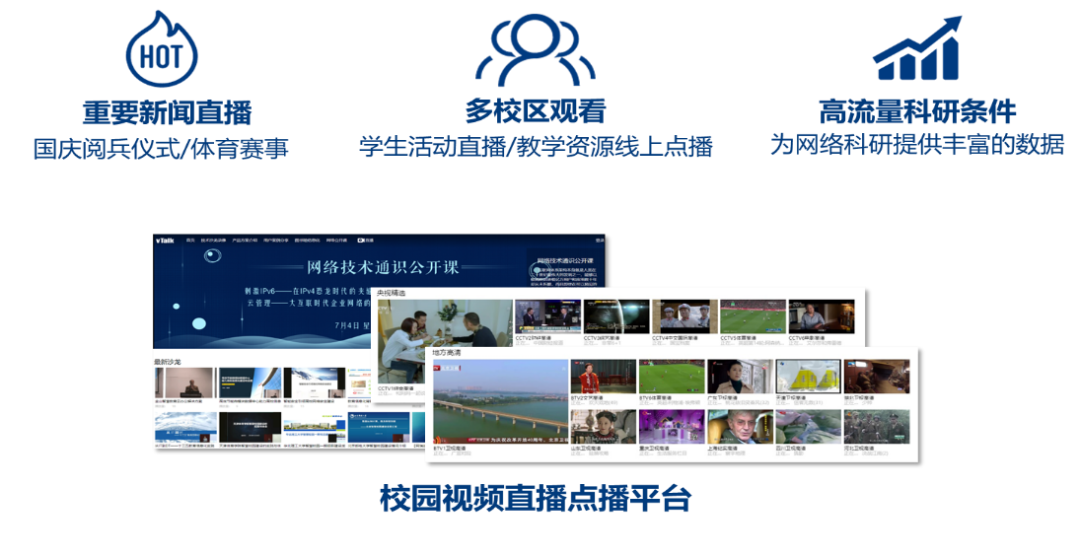
BUPT has made three main attempts in the field of IPv6 video applications, and the effects are remarkable:
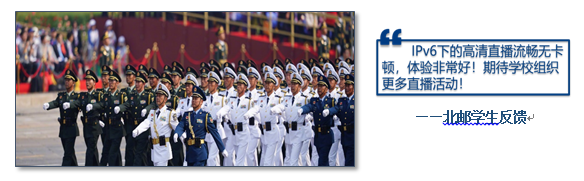
– The first attempt is IPv6-based HD live news applications. Live broadcasting of major national activities, sports events and television programs through IPv6 has become an important service provided by BUPT. On October 1, 2019, BUPT live broadcast the National Day parade for the 70th foundation anniversary of the PRC through IPv6, and the teachers and students of colleges and universities watched it on IPTV. It achieved live broadcasting of TV programs through campus intranet, avoiding consumption of traffic and saving bandwidth, so it was widely praised by teachers and students.
– The second is multi-campus school activities and curriculum teaching applications. BUPT has three campuses, and IPv6 network has become an important support for synchronizing school opening ceremonies, school celebration activities, campus singing contests and other student activities among the campuses. Besides, it is a basic security network for the campuses to share quality courses, lectures of well-known teachers.
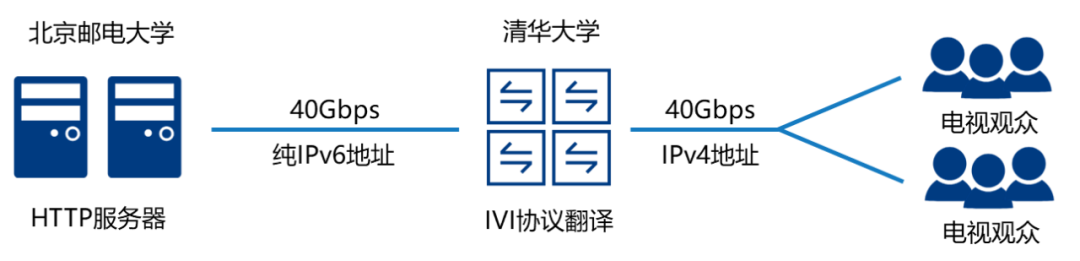
– The third is the IPv6 network testing environment of high traffic and high capacity. Our video business provides a favorable testing environment for IVI technology: two sets of HTTP servers at BUPT continuously provide live TV service at 40Gbps with pure IPv6 address, and further provide service on the Internet with IPv4 address after being translated by four IVI protocol translators located at Tsinghua University. The business is under continuous and good operation, which provides a practical support for the practicability, stability and reliability of IVI technology.
BUPT’s IPTV has been one of the popular campus network applications. It can be traced back to 2004, and has experienced four phases so far:
Phase I: Launching a video tour (2004). The campus network live TV service of BUPT provides access to TV programs for campus network users. Initially, cable TV analog signals were input into servers through tuning adapters and encoded before distribution in the campus network. In 2005, “The Same Song” program for celebrating the 50th anniversary of BUPT was live broadcast on IPTV. That was the platform's first live broadcast. During the 2006 World Cup, the platform provided HD live programs of World Cup events, which attracted many users to watch live TV programs on IPTV because of the higher definition and less delay.
Phase II: Digital and HD Transformation (2010). As the digital and high-definition transformation of domestic cable TV service progresses, the signal input source of IPTV platform is changed from analog signal into digital signal-- The TV programs, after being received by a cable TV HD STB, are encoded through the HDMI of the server before they are played. During 2010, BUPT’s multiple events, including its 60th anniversary celebration, were broadcast live on IPTV.

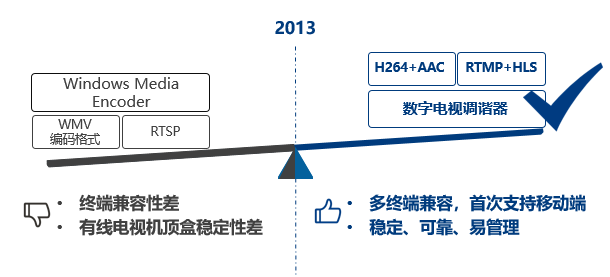
Phase III: compatibility and stability upgrades (2013). Until 2013, BUPT’s IPTV platform provided services through WindowsMidea Encoder software in WMV coded format and based on RTSP. This scheme required to call a player to play a video in the browser and was poorly compatible with non-Windows terminals. Meanwhile, the cable TV STB used was occasionally affected by system crash or software upgrades, thus disturbing the normal broadcast of a program. To solve the above problem, BUPT adjusted the software and hardware architecture of the system in the second half of 2013. A digital TV tuner was used to receive the TV signal, and a H264+AAC media encoder used to carry out live broadcast service through RTMP and HLS protocols. There was another milestone in 2013-- A distribution network was established and began to provide a stable source of IPTV to neighboring colleges and universities through RTMP to avoid duplicate construction.
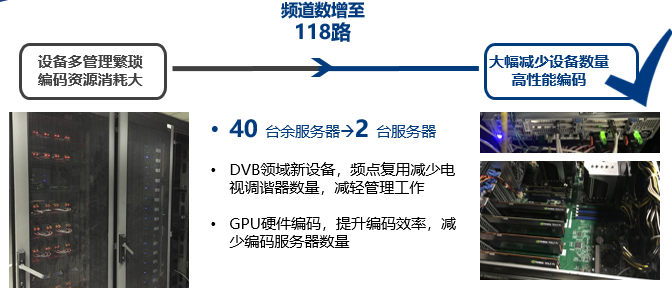
Phase IV: Encoding scheme upgrade (2017 to now). With the increase in the number of system access channels (currently 118 live channels in total, including 42 for high-definition programs), the numbers of digital TV tuners and their connected servers have also increased significantly, thus increasing the consumption of encoding resources. To save resources and reduce maintenance cost, BUPT has introduced new equipment in the DVB field to reduce the number of TV tuners used through frequency point multiplexing, and switched to the GPU encoding scheme to improve encoding efficiency and reduce the number of encoding servers. At the same time, a video distribution platform within CERNET is established in order to realize the co-construction and sharing of video service platforms among colleges and universities, reduce the cost of duplicate construction, and localize business resources to avoid the consumption of backbone network traffic.
At present, IPTV takes live TV programs as the main contents, and the dual-stack network of CERNET as the carrier. Its content resources are mainly provided by the mutual backup video sources of BUPT and Tsinghua, and supplemented by channel resources of Jilin University, Shenyang Aerospace University and others. So far, the platform has more than 100 university information teachers, and Northeast University, Zhengzhou University, University of Science and Technology of China and so on as regional secondary distribution nodes, providing video program resources for dozens of colleges and universities in the country.
Zhang Chuang, Director of the BUPT Information Technology Center, said that BUPT hopes to cooperate with more colleges and universities in the video distribution platform and its resource contents so that the platform will be able to transmit more educational resource contents such as education-related and information-related courses and training on the top of the existing TV programs and high-quality resources can be shared among colleges and universities. In this way, the platform can better use the resources of CERNET to serve the vast number of users of CERNET.
release time:2020-06-28