
China Mobile Completed Verification of Research on Key Technology of Single Carrier 400G on Backbone Transmission Network
Recently, China Mobile Research Institute as the leader, working together with partners in the industry including Huawei, ZTE, FiberHome, Nokia-SBell and YOFC, completed the verification of key technology based on single-carrier for 400G OTN, realizing the ultrahigh-speed transmission over a length of 1700km and promoted the speedy advancement of research on optical transmission technology with the ultralong haul and ultra-large capacity.
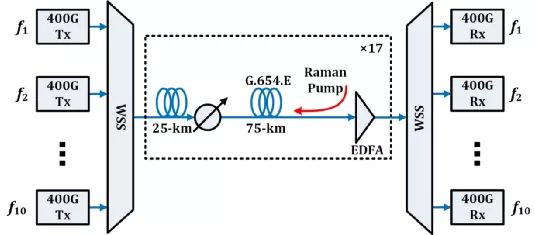
Figure 1 Test System Structure of Single-Carrier for 400G OTN
Single-carrier for 400G OTN is the core technology of the next generation transmission network, but it is still facing multiple key technical problems such as inadequate transmission distance, various encoding methods, mixed spectrum definitions, and limited total system capacity. In the test in 2019, the Single-carrier for 400G OTN could only reach a distance of 600km, unable to meet the demand of the present network. To tackle the problem, this time in the research on the key technology, relying on the good technical foundation laid by the long-term research and application experience of ultra-100G optical transmission, through accurate assessment of the damage to each part of the 400G system, China Mobile has cooperated with partners in the industry to conduct the In-depth research on many key technologies, including baud rate and channel spacing, coding format and modulation, new optical fiber attenuation characteristics and nonlinear damage, noise suppression of hybrid amplifiers based on EDFA+Raman and spectrum band expansion regarding the 400G system, and also carried out comprehensive optimization of the transmission system performance.
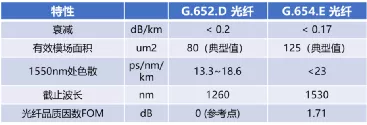
Figure 2 Parameter Comparison of G.652.D and G.654.E Fibers
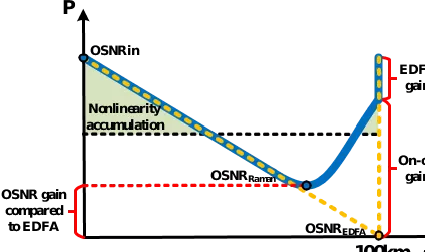
Figure 3 Mechanism of EDFA+Raman hybrid amplifier
In the comprehensive optimization, firstly, through expanding the baud rate of the single-carrier signal to about 90GBd, the equivalent modulation order can be reduced by the joint probability shaping technology, and achieve an improvement of the transceiver back-to-back performance by about 2-3dB; meanwhile, in combine with ultra-Nyquist filtering and code Crosstalk compensation algorithm, the adapted 100GHz channel spacing is ensured, which can improve the overall spectrum efficiency of transmission; we have further introduced the G.654.E fiber with ultra-low loss and large effective mode area to replace the G.652.D fiber, realizing the gaining in OSNR on the receiving end and the suppression of non-linear effects on the entire chain; finally, a hybrid amplifier based on EDFA+Raman is adopted to achieve an amplifier noise suppression of about 2.5dB. The transmission of 10 wavelengths of 400G ultra-high-speed OTN signals over the ultra-long-distance of 1700km by G.654.E optical fiber link was eventually realized through the combination of the above-mentioned multiple technical optimization methods.
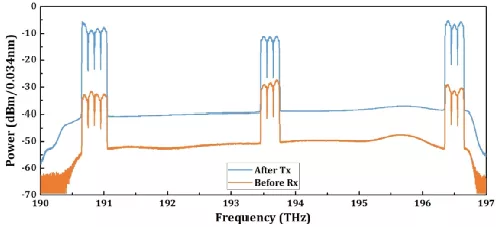
Figure 4 Signal Spectrograms of 10×400G on Transmitting Terminal and after 1700km Transmission
This time’s research on the key technology of single carrier 400G has comprehensively compared and verified the performance of various models, accumulated precious data and provided a significant reference for the intergenerational evolution from 100G to 400G of the backbone network.
(Source: InfoStone www.iccsz.com)
release time:2021-09-28
