
Special Dialogue: Online Education in the COVID-19 Response and Beyond
At 20:00 (Beijing Time) on April 24, the Special Dialogue: Online Education in the COVID-19 Response and Beyond was launched online. Mr. Qiu Yong, president of the Tsinghua University had an online meeting with the UNESCO representatives and the presidents, vice-presidents, scholars and experts from 20 colleges and universities (namely Yale University, University of Cambridge, Imperial College London, Politecnico di Milano, University of Toronto, Waseda University, Washington University in St. Louis, Australian National University, University of Chile, University of Exeter, University of Malaya, University of Nairobi, Saint Petersburg University of Technology, Massachusetts Institute of Technology, RWTH Aachen University, Shanghai New York University, Korea Advanced Institute of Science and Technology, Buenos Aires University, National University of Mongolia and Mongolian University of Science and Technology) of 15 countries on 6 continents. Together, they shared the challenges and reforms of online education in the COVID-19 response and looked for progresses by working together. Nearly 100 UNESCO officials, domestic and foreign scholars and experts, as well as media representatives sat in on the meeting.
“The virus knows no border. All countries form a closely related community of shared future.” Since the outbreak of the pandemic, President Xi Jinping has reiterated once again, “Cooperation of the international community is the most powerful weapon against the pandemic.” As one of Tsinghua’s major moves to forge the ties among higher education institutions in the battle against the pandemic, this Special Dialogue conveys the message that, to win this battle, all colleges and universities across the global should work together, help each other and adopt the open and inclusive attitudes so as to addresses the challenges related to online education, live up to their commitment to education, and contribute to the early victory against the virus.
In his address, Mr. Qiu Yong extended sincere welcome to all guests of the Special Dialogue and spoke highly of the efforts that the UNESCO had made to gather the strength of all stakeholders to combat against the pandemic. According to Qiu Yong, the COVID-19 brings about not only unprecedented impact on the world but risks and uncertainties to human beings. Many colleges and universities have stopped on-campus schooling and turned to online education. We share the same belief that education cannot be broken off. Schools can never shy from its responsibilities of imparting knowledge and cultivating people. Mr. Qiu shared that, after launching unprecedented university-wide online education for three months, the Tsinghua University had concluded three key works for online education, namely opportunity, quality and equity.
To begin with, the teachers should be trained to teach online and students allowed the access to online courses. In line with the motto that “actions speak louder than words”, the Tsinghua University decided to “postpone starting schooling and offer online courses as an alternative” on January 30. Within less than 2 weeks, over 2,600 teachers were trained on online teaching skills, within them only 15% of them have online teaching experience. On February 17, Tsinghua University managed to offer 3,923 courses online. The University also launched the special program to help students adapt to online learning and provided assistance for students who have no Internet access and those who are in different time zones. The unexpected pandemic boosts online education in an unexpected way. Colleges and universities should take immediate actions to meet the teaching and learning needs.
Also, teaching quality is always the top priority in all situation. Higher education is a complete system. To ensure the outcomes of online teaching, we need to keep the teaching order and offer classes on time. The independently developed online teaching platform has been put into use since the spring semester. The platform allows the teachers and students to interact in real time and has such features as class quiz and teaching performance evaluation. Online classes prove to be more efficient and engaging. We do not think that the screens hinder the interactions between teachers and students; instead, they are the bridges that facilitate two-way communication.
Moreover, inclusive education ensures education equity. Empowered by the technological strength and experience in remote education, Tsinghua University has provided education and training programs for the remote and impoverished areas in China for over three decades. Since the outbreak of the pandemic, the online education platform of the University has offered 1,900 public courses. In addition, the University has shared the teaching resources with colleges and universities in Wuhan: students from several colleges and universities share the same classes, teaching materials and teachers.
According to Mr. Qiu Yong, the Progress Report on Online Education during the COVID-19 Response of the Tsinghua University published by the Institute of Education, Tsinghua University reviews the efforts a university should make in response to the pandemic, which cover the decision-making process, online teaching practices, and tips from teachers and students. The year 2020 would be a new defining moment in the human history due to the pandemic and it witnesses the unprecedented booming of online education. The traditional campus-based education mode will undergo profound changes. Colleges and universities are the beacon of human civilization and the disseminator of knowledge and culture. In face of the tough challenge that decides the future of human beings, the colleges and universities should live up to their responsibilities. As Mr. Qiu said, we do not know when the pandemic will come to an end but we should always be well prepared and learn lessons from it. We will defeat the virus soon!
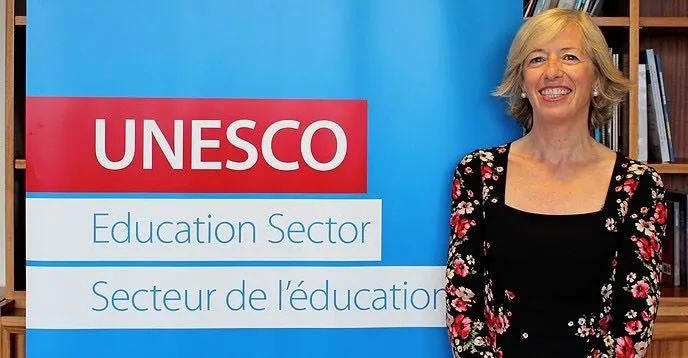
Stefania Giannini, Assistant Director-General for Education, UNESCO
Ms. Stefania Giannini, Assistant Director-General for Education, UNESCO and former Minister of Education, University and Research, recognized the efforts that Tsinghua University has made in response to the pandemic. She said that education will not and cannot stop. Online education is faced with three challenges, namely the continuity of study, the teacher’s skills and will to teach online, and the privacy and ethical concerns of online education supported by information technology. Education is changing every minute. We shoulder the responsibility to promote education equity. Global cooperation is the only solution to this crisis. It is believed that this Dialogue will further promote innovative cooperation among colleges and universities so as to better respond to the crisis and build a sustainable community of shared future for human beings.
Peter Salovey, President of Yale University, held that technologies advance the reforms of higher education. Global colleges and universities should join hands to give play to the role of innovation and wisdom and explore in-depth integration of technology and education. Stephen Toope, President of University of Cambridge, noted that the crisis reminded us that education is more than teaching and assessing. Challenges comes from the support and resources that the students need in order to receive education, the diversity of students and their conditions, and the reforms of the teaching modes faced by the teachers. For Alice Gast, President of the Imperial College London, online education is more than offering online courses. It implies the reform of the teaching mode by leveraging the strength of information and technology. Ferruccio Resta, President of Politecnico di Milano and Chairman of the Conferenza dei Rettori delle Università Italiane, maintained that the colleges and universities should be inclusive and sustainable, which is the shared responsibilities of every one. Meric Gertler, President of University of Toronto, believed that lively and efficient education is impossible without the integration of online courses and offline courses. According to Aiji Tanaka, President of Waseda University, only by adapting to the changing situations can we develop better. Andrew Martin, President of Washington University St. Louis, called for all colleges and universities to play an active role in response to the major global public health challenge.
According to UNESCO, 191 countries have closed schools due to the pandemic. Over 1.5 billion students cannot go back to schools. How to offer classes during the pandemic? How does the online classes change the traditional ones? What could the colleges and universities do to in order to better work together? Borhene Chakroun, head of the Division for Policies and Lifelong Learning System, UNESCO, Brian Schmidt, President of Australian National University and winner of the Nobel Physics Prize, Alberto Barbieri, President of Buenos Aires University, Ennio Vivaldi, President of Chile University, Steve Smith, President of Exeter University, Sung-Chul Shin, President of Korea Advanced Institute of Science and Technology, Datuk Abdul Rahim Hashim, President of Malaya University, Stephen Kiama, President of Nairobi University, and Andrey Rudskoi, President of Saint Petersburg University of Technology shared typical cases of online teaching.
The discussion panel was facilitated by Marielza Oliveira, director and UNESCO representative to the People's Republic of China. Michaela Martin, Programme Specialist of International Institute for Education Planning, UNESCO, Graham Virgo, first Vice President of University of Cambridge, Jeffrey Lehman, Managing Vice President of Shanghai New York University and former President of Cornell University, Aloys Krieg, Vice President in charge of teaching of RWTH Aachen University, Zhang Yu, Deputy Secretary of Institute of Education, Tsinghua University shared the impact brought about by online teaching practices on the teaching ideas and patterns and discussed possible teaching and research cooperation opportunities. They reached the consensus that the pandemic posed huge challenges to teaching and management on one hand and inspired the colleges and universities to make steady progresses on the other. The virus discriminates no nation or race. As long as we work together, the victory will belong to us. Colleges and universities should join hands and deepen mutual understanding across civilizations.
Edward Crawley, Professor of Massachusetts Institute of Technology and Academic Dean of Tsinghua Southeast Asia Center, and Getachew Engida, former UNESCO Deputy Secretary General and Co-director of Tsinghua CALDI made the summary speeches, holding that colleges and universities should play a significant part in the COVID-19 response. Instead of responding to the disasters passively, we should take the initiative, adapt to changes and play a leading role.
release time:2020-05-09
