
Key Core Technology SAVA for Next Generation Internet Wins the CIE Special Prize
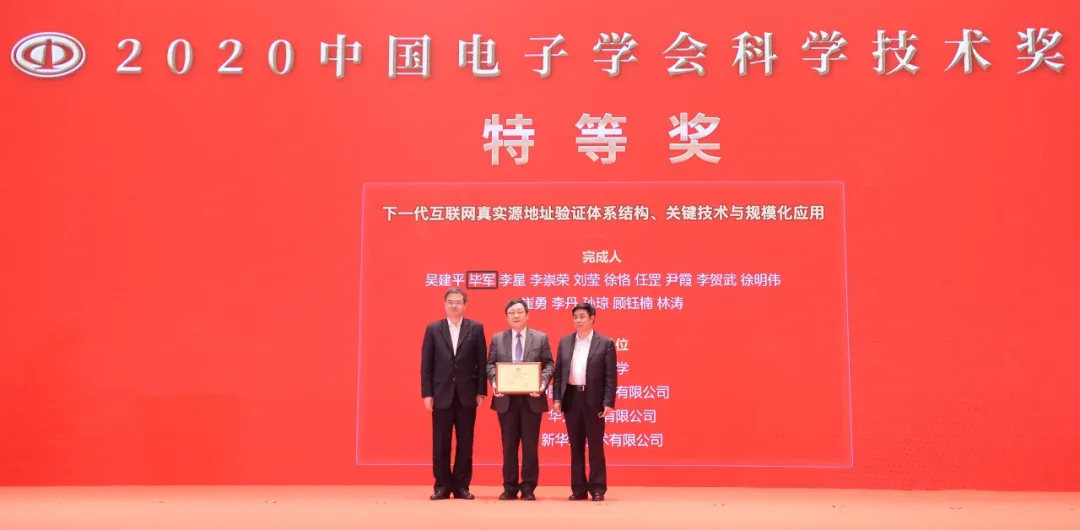
Recently, the project “Source Address Validation Architecture, Key Technology and Scale Applications for Next Generation Internet” was awarded the 2020 Special Prize for Science and Technology by the Chinese Institute of Electronics (CIE).
Zhang Jun, vice chairman of CIE and academician of the Chinese Academy of Engineering (CAE) said in his award speech, the internet architecture remains the key core technology of the internet and also the “bottleneck” in international competition in cyberspace. Facing the global major technological challenges (lack of credible source address) in open internet architecture, this project, based on the IPv6 protocol, puts forward the SAVA (Source Address Validation Architecture), which supports the accurate positioning and address sourcing for next generation internet. The project has broken through the key core technology in the safe and credible next generation internet architecture, realized the scale and industrial applications in national key departments and key industrial networks, and achieved considerable social and economic returns.
Following that the cyberspace is rapidly growing into the “fifth domain” of the humankind after land, sea, sky and outer space, it has become a strategic task concerning the national security to ensure the safe cyberspace. On account of the lack of source address validation in internet for a long time and the major potential security hazards as a result of fake source addresses, the Tsinghua University first proposed the SAVA concept on the global stage in 2005, when three levels (access, intra-domain and inter-domain) of source address validation algorithms were designed and realized, with tests and deployment in a small scale.
SAVA is original in the world and has four main innovative features: 1, “Divide-and-rule” terminal network collaborative SAVA; 2. Address synchronizing and multi-mode heterogeneous SAVA-A (Access); 3. Route synchronizing and dynamic filtering SAVA-P (Prefix); and 4. Multi-domain synchronizing and credible SAVA-X (eXternal).
In 2008, the Internet Engineering Task Force (IETF) approved that SAVA was up to standard REC 5210. This is China’s first RFC (Request for Comments) in non-information field, and meanwhile the SAVI, the first IETF team, was founded.
SAVA has produced important academic influence at home and abroad and made the Chinese voices in formulating the core internet technological standards be heard. It has also been highly appraised by well-known scholars in international internet architecture and network security field, as well as by the mainstream journals in science and technology. For example, New Scientist (a well-known British magazine) and Info Security (authoritative magazine in international information security) made special reports about the SAVA.
Based on the study on SAVA, the Tsinghua University team has published 92 important academic theses, obtained 40 national invention patents and 2 U.S. invention patents. It has also completed seven IETF internet standards and 11 standards of the China Communications Standards Association.
Meanwhile, the industrialized development of project achievements has achieved remarkable results. It is said that SAVA has applied to more than 50 model products of Huawei, H3C, ZTE, Ruijie Networks, Digital China and many other companies, with an accumulative economic returns of 16.9 billion yuan. SAVA has also been deployed in CERNET2 backbone network, university IPv6 campus network, CAS (Chinese Academy of Sciences) IPv6 network, China Telecom IPv6 testbed, and CNCERT IPv6 testbed.
It is said that the annual CIE Prize for Science and Technology is mainly granted to the collectives and individuals who has made prominent achievements or contributions in scientific research on electronic information, technological innovation and development, promotion, application and industrialized development of scientific and technological achievements. Among them, the outstanding projects can be recommended by CIE for the nomination for the State Science and Technology Award.
According to the CIE, “the first-prize projects, with the research results up to the world-leading level, playing a significant role in driving the technological advances and industrial development and obtaining major social and economic efficiency, can be awarded the special prize.” The 2020 Science and Technology Awarding Meeting granted a special prize, 24 first prizes, 19 second prizes and 24 third prizes, with annual innovative team prize vacant.
(Source: http://www.zgks.org.cn/)
release time:2021-06-02
