In November 2017, the General Office of the CPC Central Committee and the State Council issued Action Plans for Promoting the Scale Deployment of Internet Protocol Version 6 (IPv6) (abbreviated as the Action Plan).
In 2018, the Ministry of Industry and Information Technology (MIIT) and the Ministry of Education (MOE) respectively issued the Notification on Implementing Action Plans for Promoting the Scale Deployment of Internet Protocol Version 6 (IPv6).
In July 2019, the Department of Information and Communications Development of MIIT organized a special video-teleconference on the readiness to deploy and promote IPv6 network, and respectively put forward specific requirements for IPv6 reconstruction to its subordinate units, provincial (autonomous regions and municipalities) communications administration and their affiliated institutions, basic telecommunications operators at all levels, cloud services and other enterprises. |
1.Overall IPv6 deployment in the world
The number of global IPv6 users has hit 1 billion, and the number of IPv6 users in China ranks the third in the world.
According to APNIC statistics, as of February 4, 2020, the number of IPv6 users worldwide has already reached 1 billion. 10 countries/regions with the most 10 IPv6 users are in the order of India, the United States, China, Brazil, Japan, Germany, Mexico, Vietnam, the UK and France. China has seen a tremendous increase in IPv6 users. Over the past year, the number of IPv6 users in China has increased 14.3 times, and its global ranking has jumped from the 66th in early 2019 to the 3rd.
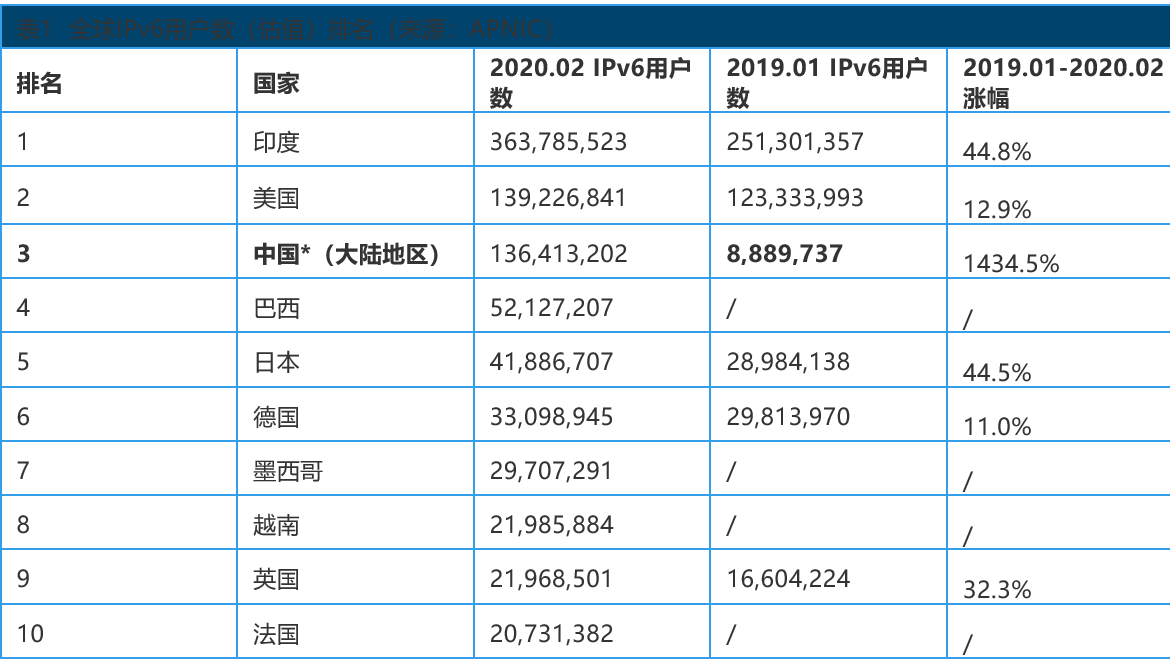
* Remark: Limited by the deployment issues of IPv6 network and monitoring nodes, APNIC’s statistical data of the overall deployment rate of IPv6 in China are inaccurate and used for reference only.
2. Scale deployment of IPv6 in China
(1) The number of active IPv6 users in China has reached 365.1 million
According to the data of the National IPv6 Development and Monitoring Platform, as of February 2020, the number of active IPv6 users * in China has reached 365.1 million. As shown in Fig. 1, from January 8 to February 1, 2020, the proportion of active IPv6 users fluctuated between 20% and 80%, and on February 1, the proportion of active IPv6 users reached as high as 77.88%.
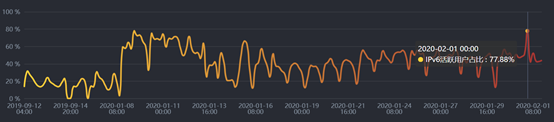
Fig. 1 Proportion of active IPv6 users in China
* Remark: The number of active IPv6 users in China refers to the number of Internet users who have access to IPv6 network in mainland China, have obtained IPv6 addresses and used IPv6 protocol to visit websites or mobile Internet applications (APP) in the past 30 days.
• 76.89% of users have been allocated IPv6 addresses
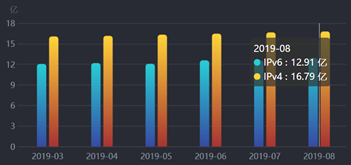
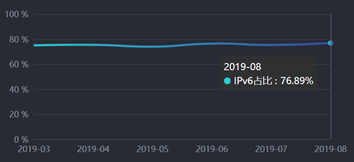
According to the data of the National IPv6 Development and Monitoring Platform, as of August 2019, the number of users allocated IPv6 addresses by basic telecom enterprises had reached 1.291 billion, accounting for 76.89% of the total users. Among them, the number of users allocated with LTE network addresses was 1.13 billion, accounting for about 89.52% of all LTE network users; and the number of users allocated IPv6 addresses in the fixed access network was 161 million, a decrease of 1 million users compared with that in May.
Fig.2 Number of broadband IPv6/IPv4 Users
Fig.3 Proportion of broadband IPv6 users
(2) Rapid growth of IPv6 traffic
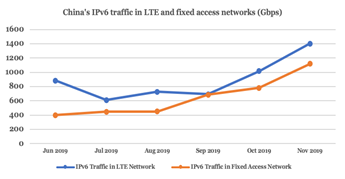
According to the abstract of Report on China IPv6 Development published by a senior network engineer of Chinese Panel Committee for Promoting IPv6 Scale Deployment on APNIC blog: As of November 2019, the IPv6 traffic of China’s LTE core network has reached 1.399Tbps, up 129% as against July 2019. Due to the significant growth in the past six months, IPv6 traffic on the fixed network has also followed close behind.
Fig. 4 IPv6 traffic of LTE and fixed access networks in China (from June 2019 to November 2019) (Data source: APNIC blog)
Traffic between operators has also grown rapidly, up to 200.72Gbps from 16.46Gbps in early 2019, and the performance of interconnected networks between operators has also been improved continuously.
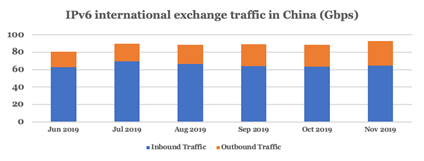
In terms of the international traffic, the total IPv6 traffic has increased nearly 15% in the past six months, reaching above 92Gbps as of November 2019. Among them, the inbound traffic is more than twice the outbound traffic. The significant difference between them points to the necessity of improving IPv6 application resources in China.
Fig. 5 IPv6 International exchange traffic in China (from June 2019 to November 2019) (Data source: APNIC blog)
(3) Completion of IPv6 upgrading for network infrastructure
According to the abstract of Report on IPv6 Development in China published by a senior network engineer of Chinese Panel Committee for Promoting IPv6 Scale Deployment on APNIC blog: Although IPv6 has been deployed in China since 2012, it is not until recently that IPv6 has become a “standard” of the entire network infrastructure, relying more on the dual stack protocol.
• In 2018-All backbone networks and LTE core networks have completed IPv6 upgrade and started to provide services to users.
• In 2019-All Internet backbones IXPs have supported IPv4/IPv6 dual stack protocol.
• In 2019-All MAN and fixed access networks have completed IPv6 upgrade.
The Action Plan has played a part in this growth. IPv6 network performance has been greatly improved, almost approaching the performance of IPv4 network (as shown in the figure below).
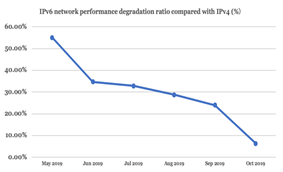
Fig. 6 IPv6 network performance degradation ratio compared with IPv4 (from May 2019 to October 2019) (Data source: APNIC blog)
According to the abstract of Report on China IPv6 Development published by a senior network engineer of Chinese Panel Committee for Promoting IPv6 Scale Deployment on APNIC blog: As of November 2019, the total IPv6 address blocks in China have reached 47,851 (/32), which can meet China’s current demand for IPv6. However, with the rapid development of Internet of Things, vehicle networks and industrial networks, the demand is expected to grow further in the future.
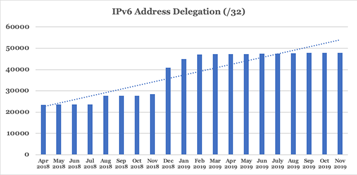
Fig.7 Growth of IPv6 address blocks in China (from April 2018 to November 2019) (Data source: APNIC blog)
Meanwhile, over a third of China’s autonomous systems (ASes) have announced their plans for IPv6 changes.
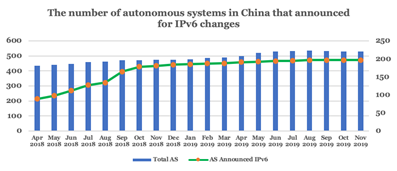
Fig.8 The Number of autonomous systems in China that announced for IPv6 changes (from April 2018 to November 2019) (Data source: APNIC blog)
(4) Application infrastructure initially acquiring IPv6 service capability
As reported by People’s Posts and Telecommunications News, basic telecom enterprises have completed the IPv6 renovation of all super-large, large and medium-sized data centers, while other data center operators have completed the IPv6 renovation of some large data centers. By the end of August 2019, typical CDN enterprises claim over 1,000 CDN nodes supporting IPv6 all over the country, among which, Wangsu, ChinaCache, AliCloud and Tencent Cloud have reached 100% in terms of their IPv6 coverage capacity across the country. The TOP10 cloud service platform enterprises have completed over 50% of the renovation of IPv6 cloud products, and preliminarily have the capability to provide IPv6 services nationwide. Basic telecom enterprises have all completed double stack renovation of recursive servers, and fully support IPv6 address resolution.
(5)Increasingly mature development environment for fixed and mobile IPv6 terminals
According to a report by People’s Post and Telecommunications News, basic telecommunications enterprises, communication equipment manufacturers and mobile terminal manufacturers have accelerated the iterative upgrading of their products. As a result, the support for IPv6 network equipment and terminal equipment has been greatly enhanced.
By the end of August 2019, market mainstream LTE terminals and smart home gateways have supported IPv6, among which, the IPv6 support rate of intelligent gateway has reached 85%, 79% and 72%, for China Telecom, China Mobile, and China Unicom, respectively.
(6)Positive progress made by website and IPv6 application upgrading and renovation
According to a report by People’s Post and Telecommunications News, the portals, online business halls of basic telecommunications enterprises and TOP10 proprietary mobile Internet applications have all completed IPv6 renovation tasks as required.
Major Internet enterprises have prepared implementation plans for IPv6 upgrading and renovation for Internet applications characteristic of a large number of users and a concentrated traffic, and relevant renovation work is being implemented in an orderly manner.
The preliminary test results of IPv6 concentrations of the top 50 commercial Apps and 30 proprietary Apps of basic telecom enterprises show that the IPv6 support of 30 proprietary Apps of basic telecom enterprises is relatively desirable, and the average IPv6 concentration is higher than that of the top 50 commercial Apps.
3.IPv6 support in colleges and universities in China
(1)IPv6 support for college and universities portals in China
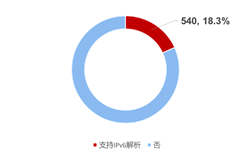
According to List of National Institutions of Higher Learning in 2019 published by MOE, as of June 15, 2019, there are 2,956 colleges and universities in China. According to the IPv6 Development and Monitoring Platform (http://ipv6c.cngi.edu.cn), the development trend monitoring of IPv6 Websites of national institutions of higher learning: As of January 2, 2020, portals of 540 colleges and universities support IPv6 resolution, accounting for 18.3%; and portals of 444 colleges and universities support IPv6 access, accounting for 15%.
Fig.9 Portals of colleges and universities supporting IPv6 resolution (Source: http://ipv6c.cngi.edu.cn)
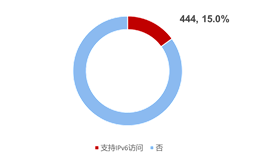
Fig.10 Portals of colleges and universities supporting IPv6 access (Source: http://ipv6c.cngi.edu.cn)
(2)IPv6 support for portals of colleges and universities under direct supervision of ministries and commissions
According to the IPv6 Development and Monitoring Platform (http://ipv6c.cngi.edu.cn), the development trend monitoring of IPv6 Websites of national institutions of higher learning: As of January 2, 2020, of 113 colleges and universities under direct supervision of ministries and commissions, portals of 70 colleges and universities support IPv6 resolution, accounting for 61.9%; and portals of 63 colleges and universities support IPv6 access, accounting for 55.8%.
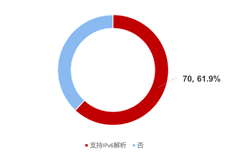
Fig.11 Portals of colleges and universities under direct supervision of ministries and commissions supporting IPv6 resolution (Source: http://ipv6c.cngi.edu.cn)
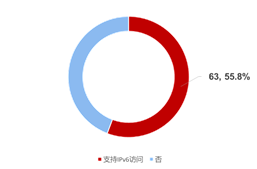
Fig.12 Portals of colleges and universities under direct supervision of ministries and commissions supporting IPv6 access (Source: http://ipv6c.cngi.edu.cn)
Remark: 113 colleges and universities under direct supervision of ministries and commissions do not include National Defence University and National University of Defense Technology.
(3)IPv6 support for portals of colleges and universities of various types
According to the IPv6 Development and Monitoring Platform (http://ipv6c.cngi.edu.cn), the development trend monitoring of IPv6 Websites of national institutions of higher learning: As of January 2, 2020, portals of Double First-class universities are generally quite good in terms of IPv6 support, already surpassing 60%. The support rate for IPv6 for portals of general undergraduate universities, higher vocational colleges and adult education is still relatively low, and the renovation needs to be accelerated.
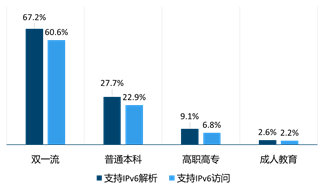
Fig.13 Portals of various types of colleges and universities supporting IPv6 (Source: http://ipv6c.cngi.edu.cn)
(4)Portals of Double First-class universities supporting IPv6
According to the IPv6 Development and Monitoring Platform (http://ipv6c.cngi.edu.cn), the development trend monitoring of IPv6 Websites of national institutions of higher learning: As of January 2, 2020, of Double First-class universities, ports of 92 universities support IPv6 resolution, accounting for 67.2%; and 83 university websites are IPv6 accessible, accounting for 60.6%.
Among them, 34 universities allow for IPv6 resolution among the Double First-class universities being constructed, accounting for 82.9%. 32 universities websites are IPv6 accessible, accounting for 78%. 58 universities websites allow for IPv6 resolution among the First-class Disciple universities being constructed, accounting for 60.4%. 51 universities websites are IPv6 accessible, accounting for 53.1%.
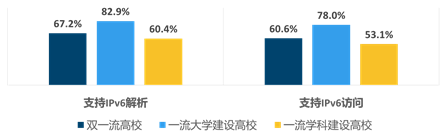
Fig.14 Portals of Double First-class universities supporting IPv6
(Source: http://ipv6c.cngi.edu.cn )
(5) IPv6 support for college and universities portals in various regions of China
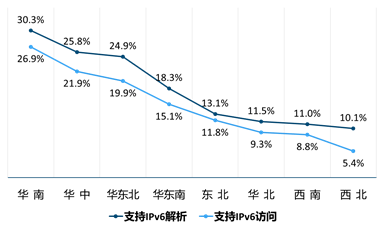
According to the IPv6 Development and Monitoring Platform (http://ipv6c.cngi.edu.cn), the development trend monitoring of IPv6 Websites of national institutions of higher learning: As of January 2, 2020, over 20% of portals of colleges and universities in South China and Central China support IPv6; The support rate of IPv6 for portals of colleges and universities in North China, Southwest China and Northwest China is relatively low, below 10%.
Fig.15 IPv6 support for portals of colleges and universities in various regions of China
(Source: http://ipv6c.cngi.edu.cn )
Remark:
Northeast China: Jiangsu, Anhui, Shandong
North China: Beijing, Tianjin, Hebei, Inner Mongolia, Shanxi
Southeast China: Shanghai, Zhejiang, Jiangxi, Fujian
Central China: Hubei, Hunan, Henan
Southwest China: Yunnan, Guizhou, Chongqing, Sichuan (Tibet)
South China: Guangdong, Guangxi, Hainan, Shenzhen
Northeast China: Liaoning, Heilongjiang, Jilin
Northwest China: Xinjiang, Shaanxi (Ningxia), Gansu (Qinghai)
(6)IPv6 support for portals of provincial colleges and universities across China
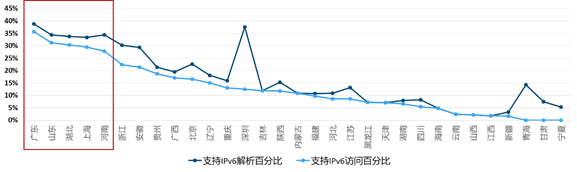
According to the IPv6 Development and Monitoring Platform (http://ipv6c.cngi.edu.cn), the development trend monitoring of IPv6 Websites of national institutions of higher learning: As of January 2, 2020, compared with those in other provinces and municipalities, IPv6 support for portals of colleges and universities in Guangdong, Shandong, Hubei, Shanghai and Henan is rather good, with an IPv6 resolution rate of over 30%, and an IPv6 access rate of over 25%; and IPv6 support rate for portals of colleges and universities in Shanxi, Jiangxi, Xinjiang, Gansu, and Ningxia is relatively low.
Fig.16 Portals of provincial colleges and universities supporting IPv6 (Source: http://ipv6c.cngi.edu.cn)
release time:2020-04-09